Most pipeline reviews are status updates disguised as strategy sessions. A rep recaps each deal, the manager nods, and everyone leaves with the same information they walked in with. The forecast doesn’t get more accurate. The at-risk deals don’t get caught. The meeting just happened.
A pipeline review that finds real risk looks different. It inspects specific signals — call activity, stakeholder engagement, stage timing, and close date movement — and uses those signals to decide which deals need intervention, which need to be re-staged, and which need to come out of the forecast entirely.
Why Most Pipeline Reviews Fail
Three structural problems:
1. They’re rep-narrated, not signal-driven. The rep tells you what they think is happening. But what they think is happening and what the data shows are often different. A rep says the deal is “moving forward.” The data shows no call activity in three weeks, a single point of contact, and a close date that’s been pushed twice.
2. They cover too many deals at surface level. A 30-minute review that touches 15 deals inspects none of them. The manager hears a sentence about each deal and moves on. The deals that need real attention get the same two minutes as the deals that are fine.
3. They don’t connect to the forecast. The pipeline review and the forecast call are separate meetings with separate data. A deal can survive a pipeline review on Tuesday and blow up the forecast on Friday because no one connected the signals.
The Signals That Predict Deal Risk
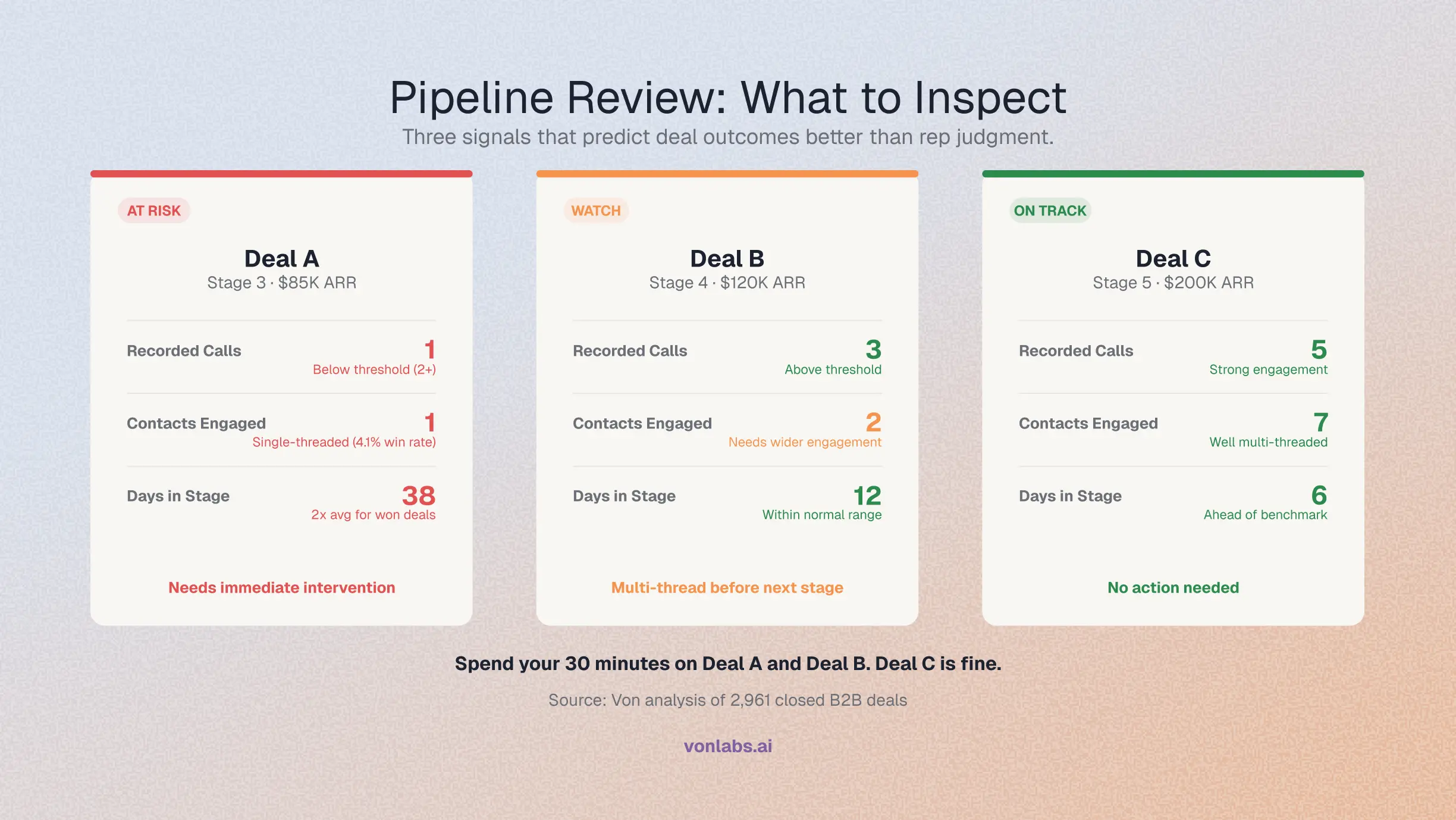
In an analysis of nearly 3,000 closed B2B deals, three signals predicted deal outcomes more reliably than rep judgment or CRM stage alone. (For the full data, see Deal Risk Detection.)
Call Activity
The inflection point is two recorded calls. Deals that reach two calls win at 3.6x the rate of deals with zero or one. This is the single most controllable signal in your pipeline.
Pipeline review question: “How many recorded calls have we had on this deal? If it’s fewer than two, what’s the plan to get the next one scheduled?”
Multi-Threading
Single-threaded deals (one contact) close at 4.1% — worse than deals with zero contacts logged (9.9%). A single point of contact is not a pipeline deal. It’s a conversation.
Pipeline review question: “Who else on their side has been involved in the evaluation? If it’s one person, what’s the plan to get wider?”
Stage Timing
Won deals move through stages at a consistent pace. Lost deals stall. The data shows that 77% of lost deals never make it past the discovery stage. And deals that sit in legal for 43 days (vs. 3.6 days for won deals) are almost certainly dead.
Pipeline review question: “How long has this deal been in the current stage? Is that consistent with our won-deal benchmarks, or is it stalling?”
The 30-Minute Pipeline Review Framework
This framework replaces the deal-by-deal status update with a signal-driven inspection. It works for weekly 1:1s between a manager and a rep.
The key shift: you spend 15 of 30 minutes on the 3–5 deals that need attention, not 2 minutes each on 15 deals that don’t. The deals that are fine don’t need airtime. The deals that are at risk need all of it.
What Changes When the Signals Are Automatic
The framework above works with manual inspection. But it requires someone to pull the call activity data, count the contacts, check the stage timing, and cross-reference the close date history before the meeting. That prep work takes 30–60 minutes per rep — which means the manager spends more time preparing for the review than running it.
An intelligence layer like Von does this automatically. It monitors call activity, stakeholder count, stage timing, and close date movement across every deal in the pipeline, flags the ones showing risk signals, and surfaces them before the review starts. The manager walks in knowing which deals to inspect. The rep walks in knowing which signals to address.
The result: the pipeline review becomes a coaching conversation about the 3–5 deals that matter, not a data-gathering exercise across 15 that don’t. (For more on how this works, see The AI VP of RevOps.)
Frequently Asked Questions
How often should you run pipeline reviews? Weekly is the standard cadence for B2B sales teams. Thirty-minute 1:1 sessions on the same day each week with a consistent agenda produce the best results. Teams with longer sales cycles (6+ months) can run biweekly, but weekly is better for catching risk early.
What questions should a sales manager ask in a pipeline review? Focus on three signal areas: (1) Call activity — “How many recorded calls have we had? When was the last one?” (2) Multi-threading — “Who else on their side is involved?” (3) Stage timing — “How long has this deal been in the current stage?” These three signals predict deal outcomes more reliably than rep judgment alone.
How many deals should you review in a pipeline meeting? Three to five. Not fifteen. Spend 15 of your 30 minutes on the deals showing risk signals — low call activity, single-threaded, stalled stage timing. The deals that are progressing normally don’t need airtime. The at-risk deals need all of it.
What is the difference between a pipeline review and a forecast call? A pipeline review inspects individual deal health — is this deal real, is it progressing, what’s the risk? A forecast call aggregates those deals into a number — what will we close this quarter? The pipeline review should feed the forecast, not run separately from it. The framework above includes a 7-minute forecast impact block for exactly this reason.
How do you identify at-risk deals before a pipeline review? Look for three signals: (1) Fewer than two recorded calls past the discovery stage. (2) A single point of contact in mid-to-late stages. (3) Stage duration that exceeds your won-deal benchmarks by 2x or more. An intelligence layer like Von flags these automatically across every deal in the pipeline.
RevOps Playbook Series
- How to Run a Pipeline Review That Finds Real Risk
- How to Build a Sales Forecast That Leadership Trusts
- How to Build a QBR Deck in Minutes, Not Days
- How to Set Up Territory Planning Without a Dedicated Analyst
- How to Track Competitor Mentions Across Your Deal History
- How to Measure Rep Performance Beyond Quota Attainment
- How to Keep Your CRM Clean Without Policing Reps
- How to Prep for a Customer Call in 5 Minutes