Most deals don’t die suddenly. They show warning signs weeks before the loss — a champion who stops responding, a deal stuck in the same stage too long, a single-threaded opportunity with no backup contact. The problem is that these signals are scattered across CRM fields, call recordings, and email threads, and no single tool sees all of them at once.
In an analysis of nearly 3,000 closed B2B deals, Von identified the specific signals that separate deals that close from deals that die. The patterns are consistent, measurable, and visible early enough to act on.
The Signals That Predict Deal Outcomes
Call Activity Is the Strongest Controllable Lever
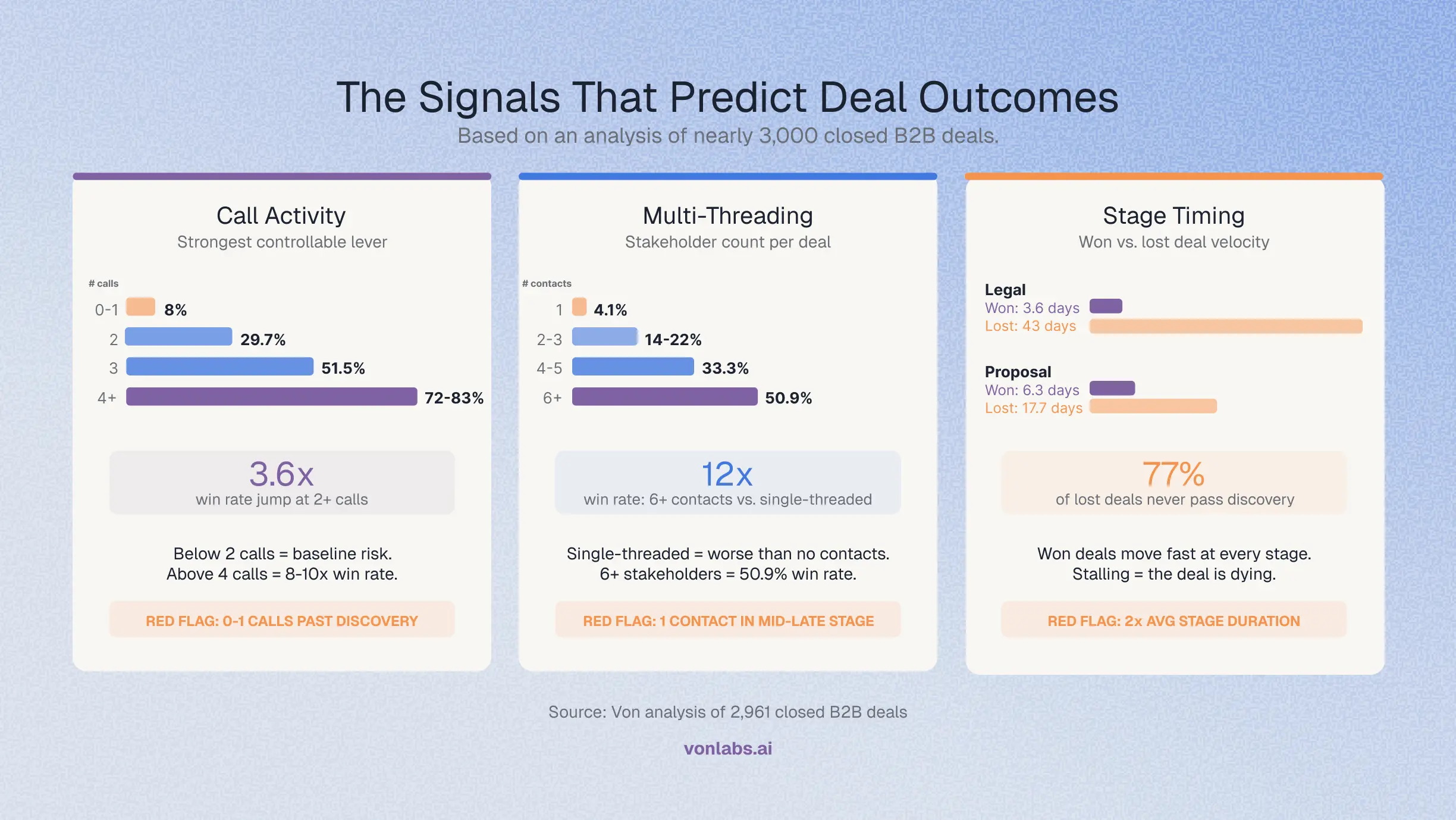
The single biggest predictor of whether a deal closes is how many substantive conversations happen during the sales cycle. The data is stark:
The inflection point is two recorded calls. Below that threshold, deals close at roughly the baseline rate regardless of other factors. Above it, win rates jump 3.6x. This is the most actionable signal in the dataset because it’s directly controllable by the rep and the manager.
Multi-Threading Separates Winners from Losers
Single-threaded deals — opportunities with only one contact — close at 4.1%, worse than deals with zero logged contacts. The relationship is linear and steep:
A deal with six or more stakeholders closes at 12x the rate of a single-threaded deal. If your pipeline review doesn’t surface contact count per deal, you’re missing one of the strongest risk indicators available.
Stage Timing Reveals Stalled Deals Before Reps Admit It
Won deals move faster than lost deals at every stage. The divergence is most dramatic in late stages:
- Won deals close legal in 3.6 days on average. Lost deals stall for 43 days.
- Won deals move through proposal in 6.3 days. Lost deals take 17.7 days.
- 77% of lost deals never make it past the discovery stage.
Any deal sitting in a stage longer than the won-deal average for that stage is showing risk. The longer it sits, the more likely it ends in a loss.
Why Pipeline Reviews Miss These Signals
Most pipeline reviews happen weekly, last 30-60 minutes, and cover 10-20 deals. The manager asks the rep for an update. The rep gives a subjective assessment. The CRM fields confirm or contradict it, but nobody has time to cross-reference the call recordings, check the email thread, or count the stakeholders.
The signals above — call activity, multi-threading, stage timing — are all measurable. But measuring them requires connecting CRM data with conversation data and activity data simultaneously. That’s the reconciliation problem that point solutions leave behind.
Conversation intelligence tools surface what was said on the call, but they don't cross-reference it with CRM data or email threads. For more on this scope limitation, see Best Gong Alternative in 2026: Beyond Call Recording.
What Catches Risk at Scale
An intelligence layer like Von monitors these signals across every deal in the pipeline continuously — not once a week in a pipeline review. It connects CRM stage data with call recordings and email activity to flag risk based on what’s happening in the deal, not what the rep reported.
When a deal has been in legal for 10 days with no activity, the system flags it. When a deal has only one contact and no recorded calls past discovery, the system flags it. When a champion who was active on three calls goes silent for two weeks, the system flags it — because it read the calls, not because someone updated a picklist.
For more on how this connects to forecast accuracy, see Why Your Sales Forecast Is Wrong.
Frequently Asked Questions
What are the most common deal risk signals? The strongest predictors are call activity (deals with fewer than two recorded calls close at baseline rates), multi-threading (single-threaded deals close at 4.1%), and stage timing (deals that stall past the average duration for won deals at that stage). Other signals include champion disengagement, missing next steps, and repeated close-date changes.
How early can you detect a deal is at risk? Most risk signals are visible weeks before the deal is lost. Stage timing divergence shows up mid-cycle. Call activity and multi-threading are measurable from the first few weeks of the opportunity. Champion disengagement can be detected as soon as the contact stops appearing on calls or responding to emails.
Can CRM data alone detect deal risk? Partially. CRM fields capture stage, close date, and amount, but the most predictive signals — champion engagement, conversation sentiment, stakeholder involvement — live in unstructured data (calls and emails). Detecting risk at scale requires connecting structured CRM data with unstructured conversation data.
What is the difference between deal health and deal risk? Deal health is a composite score that reflects the overall state of a deal. Deal risk is a specific flag that indicates a deal is trending toward loss. A deal can be healthy overall but show a specific risk signal (e.g., single-threaded). Risk detection is about surfacing those specific signals early enough to intervene.
Revenue Intelligence Series
- Gong vs. Clari vs. Momentum: Which Revenue Intelligence Platform Fits Your GTM Stack?
- What Is Revenue Intelligence? (And Why Point Solutions Only Solve Part of It)
- Why Your Sales Forecast Is Wrong: The Real Causes of Forecast Inaccuracy
- CRM Data Entry Is Killing Rep Productivity
- The AI VP of RevOps: What This New Role Means
- Deal Risk Detection: Catching At-Risk Deals Early
- Clari Alternative in 2026: Why Teams Are Switching
- Gong Alternative: When Call Recording Isn't Enough
- Momentum + Salesforce: What It Means for GTM Teams
- Agentic AI for Revenue Teams: What It Is