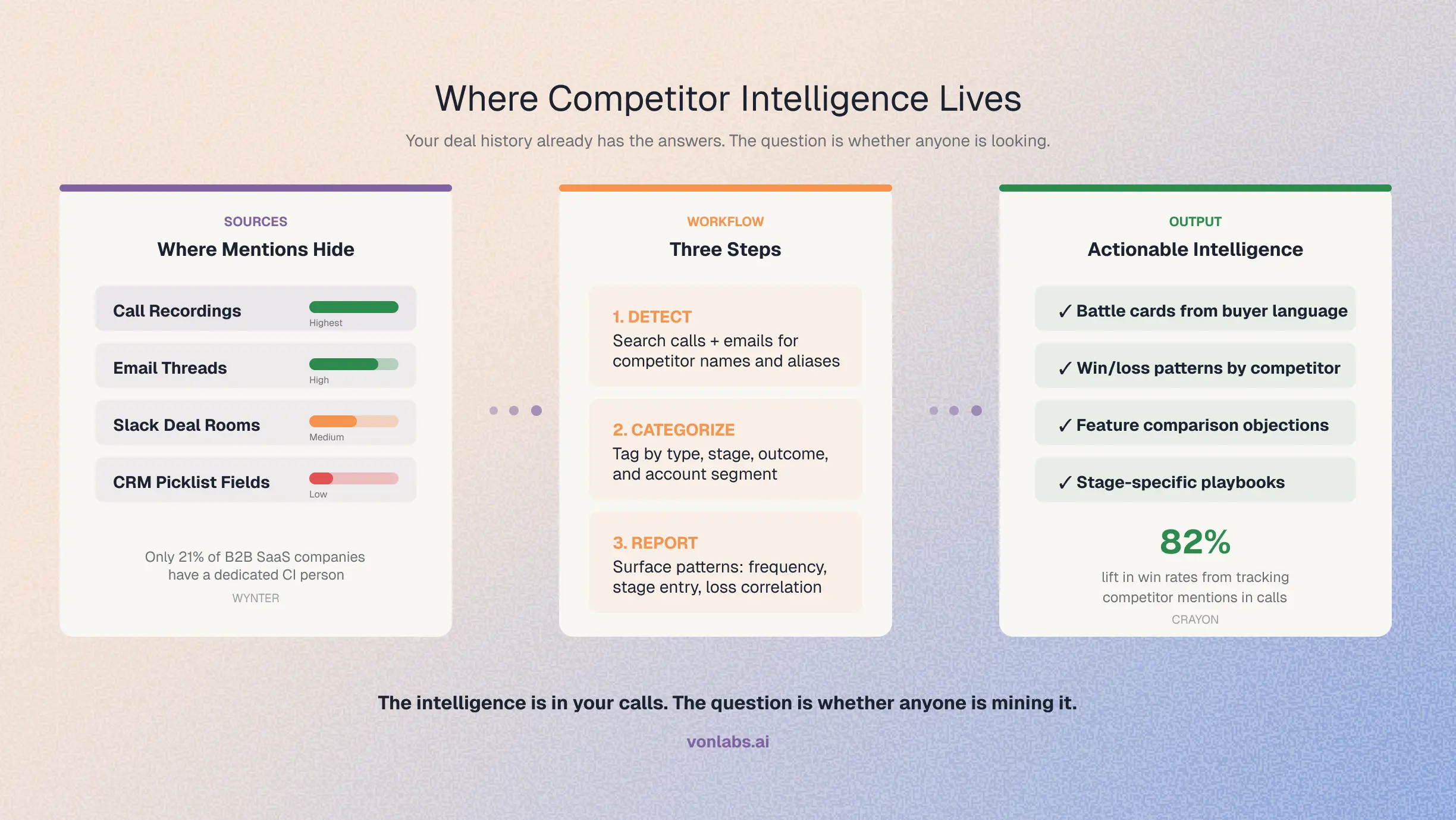
According to Wynter’s State of Competitive Intelligence report, sales calls are the number one source of competitive intelligence for product marketing managers. Yet only 21% of B2B SaaS companies have a dedicated CI person or team. The rest rely on anecdotes: a rep mentions a competitor in a deal review, someone forwards a call snippet, or a loss reason gets logged as "Lost to Competitor" with no detail on which competitor or why.
The intelligence is sitting in your call recordings. The problem is that no one has time to listen to hundreds of calls to find it.
Why Manual Competitor Tracking Fails
Most teams track competitors through a CRM picklist field. A rep selects "Competitor X" from a dropdown when they create or update an opportunity. This approach has three problems:
Low population rates. Reps fill in the competitor field on fewer than 20% of opportunities in most orgs. The field is optional, the dropdown is long, and the rep is already behind on CRM updates.
No context. A picklist tells you that Competitor X was mentioned. It does not tell you what the prospect said about them, whether the mention was positive or negative, what feature comparison came up, or at what stage the competitor entered the conversation.
Single-source bias. The CRM field captures what the rep remembers to log. It misses competitor mentions in discovery calls, email threads, and follow-up conversations where the prospect brings up alternatives unprompted.
Wynter’s research confirms the downstream effect: 37% of sales teams mostly ignore the competitive intelligence that product marketing provides. When the intelligence is based on incomplete data, reps stop trusting it.
What to Track: Five Types of Competitor Mentions
Not all competitor mentions are equal. Categorize them by type to extract actionable intelligence:
Each type requires a different response. A direct comparison needs a battle card. An incumbent vendor needs a migration playbook. A feature reference needs a positioning guide. Tracking the type — not just the name — is what makes the intelligence actionable.
Where to Find Competitor Mentions
Competitor mentions live in four places:
Call recordings are the richest source because they capture what the buyer said in their own words, not what the rep remembered to log. But manually reviewing calls is not scalable. A team with 10 reps running 5 calls per day generates 250 calls per week. No one is listening to all of them.
Building a Competitor Intelligence Workflow
A repeatable workflow has three steps:
1. Detect. Search across all recorded calls and emails for competitor names, product names, and common aliases. Include misspellings and abbreviations — prospects say "Salesforce automation" when they mean Momentum, or "the Gong thing" when they mean conversation intelligence in general.
2. Categorize. Tag each mention by type (direct comparison, incumbent, previous vendor, feature reference, unprompted). Tag by deal stage, deal outcome (won/lost/open), and account segment. This turns raw mentions into structured data.
3. Report. Surface the patterns: which competitors appear most often, at which stage they enter, which ones correlate with losses, and what specific objections or feature comparisons come up. Deliver this to product marketing monthly and to sales leadership in deal reviews.
Companies that formalize this process see measurable results. Crayon reports that teams using conversation intelligence to track competitor mentions see an 82% lift in win rates. The lift comes from preparation: when reps know which competitor will come up and what the prospect will say about them, they handle the conversation better.
What Changes at Scale
The workflow above works manually for a team tracking 2–3 competitors across 50 deals. It breaks at scale. When you have 500 deals, 10 competitors, and thousands of recorded calls, the detection step alone becomes a full-time job.
An intelligence layer like Von can search across your entire call and email history in a single query. Ask "which deals mentioned Gong in the last 90 days and what did the prospect say about them?" and get a structured answer with quotes, deal context, and outcome data — across hundreds of conversations, not just the five a manager can review.
For more on how conversation intelligence fits into the broader revenue stack, see Gong Alternative: When Call Recording Is Not Enough.
Frequently Asked Questions
What is the best source of competitive intelligence for sales teams? Sales calls. According to Wynter’s State of Competitive Intelligence report, sales calls are the number one source of competitive intelligence for product marketing managers in B2B SaaS. They capture what buyers say in their own words about competitors, features, and buying criteria — context that CRM fields and external monitoring cannot provide.
How do you track competitor mentions in a CRM? Most CRMs offer a multi-select picklist field on the opportunity object for competitor names. This captures which competitors were involved but not what was said about them. For richer intelligence, supplement the CRM field with call transcript analysis that captures the context, sentiment, and stage of each mention.
How often should you update competitive intelligence? Monthly at minimum. Review competitor mention patterns, update battle cards with new objections or feature comparisons, and share findings with product marketing and sales leadership. Trigger an immediate update when a competitor launches a new product, changes pricing, or gets acquired.
What is the ROI of a competitive intelligence program? Companies with formal CI programs report 63–84% higher win rates according to AMA research. The three primary ROI metrics are competitive win rate against named competitors, battle card adoption rate among reps, and time saved on manual research.
Can AI track competitor mentions automatically? Yes. Conversation intelligence tools can detect competitor names, aliases, and product references in call recordings and email threads. An intelligence layer goes further by cross-referencing mentions with CRM data (deal stage, outcome, account segment) to surface patterns across your entire deal history.
RevOps Playbook Series
- How to Run a Pipeline Review That Finds Real Risk
- How to Build a Sales Forecast That Leadership Trusts
- How to Build a QBR Deck in Minutes, Not Days
- How to Set Up Territory Planning Without a Dedicated Analyst
- How to Track Competitor Mentions Across Your Deal History
- How to Measure Rep Performance Beyond Quota Attainment
- How to Keep Your CRM Clean Without Policing Reps
- How to Prep for a Customer Call in 5 Minutes