According to Gartner, 75% of high-growth companies will adopt RevOps models by late 2026. But most RevOps teams are still 1-3 people, stretched across CRM administration, pipeline reporting, forecast prep, territory planning, and tool management. The role has grown 300% in scope over the past two years. The headcount hasn’t kept up.
The result: RevOps leaders spend their weeks pulling data from disconnected systems, reconciling what each one says, and building the narrative for leadership. The strategic work — identifying patterns, coaching on deal execution, redesigning processes — gets squeezed into whatever time is left.
An AI VP of RevOps isn’t a job title. It’s what happens when an intelligence layer handles the analysis, reconciliation, and pattern recognition that used to require a senior hire.
What a RevOps Leader Spends Their Week On
A typical RevOps week looks like this:
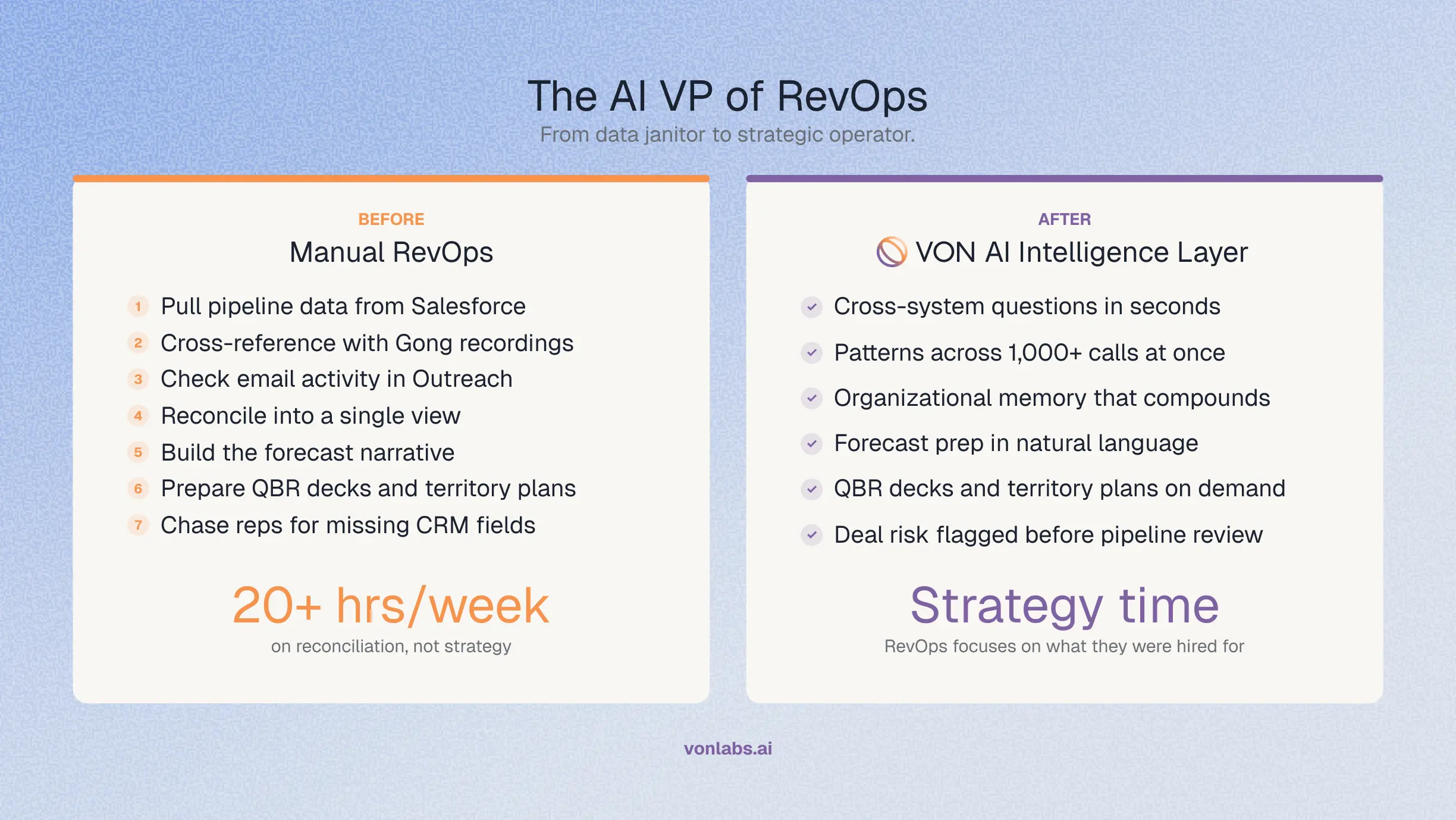
- Pull pipeline data from Salesforce. Cross-reference it with call recordings from Gong. Check email activity in Outreach. Reconcile the three into a single view of deal health.
- Build the forecast narrative for leadership. Identify which deals are real, which are at risk, and why — manually, by reading calls and checking CRM fields.
- Run pipeline coverage calculations. Flag deals that have stalled. Chase reps for updates on deals with missing fields.
- Prepare QBR decks, territory plans, and coaching reports. Each one requires pulling data from multiple systems and formatting it for a different audience.
Most of this work is reconciliation — stitching together insights from tools that each see a slice of the picture. (For more on why this happens, see What Is Revenue Intelligence?)
What an AI RevOps Layer Does Instead
An intelligence layer like Von connects to the entire tech stack — CRM, call recorder, email, data warehouse — and reasons across all of them simultaneously. It doesn’t replace the RevOps leader. It handles the reconciliation work so the leader can focus on strategy.
In practice, that means:
- Answering cross-system questions in natural language. "Which deals in my forecast are at risk and why?" requires connecting CRM stage data with what was said on the last call. An intelligence layer does that in seconds, across every deal in the pipeline.
- Identifying patterns humans can’t see at scale. In an analysis of nearly 3,000 B2B deals, Von found that deals with two or more recorded calls closed at 3.6x the rate of deals with zero calls. Multi-threaded deals (6+ stakeholders) closed at 12x the rate of single-threaded deals. These patterns are invisible when you’re reviewing five deals at a time in a pipeline meeting.
- Building organizational memory. Your churn definitions, fiscal calendar, competitor field mappings, and team terminology are learned once and applied everywhere. When one user corrects the system, that correction applies to everyone. A new RevOps hire takes months to learn this context. An intelligence layer compounds it from day one.
- Executing RevOps deliverables directly. Pipeline analysis, forecast prep, QBR decks, territory planning, deal risk identification, coaching insights — all done in natural language, all grounded in the same unified context.
The Shift: From Data Janitor to Strategic Operator
The RevOps role was never supposed to be about spreadsheet reconciliation. It was supposed to be about designing the revenue engine — the processes, incentives, and systems that make a GTM team predictable and scalable.
When an intelligence layer handles the data work, RevOps leaders get to do what they were hired for: redesigning stage criteria based on what the data shows, coaching managers on deal execution patterns, identifying where the GTM motion is breaking down, and building the operating cadence that keeps the revenue engine running.
This is already happening. Bloomreach rolled out an AI intelligence layer to 400+ users across their GTM team. DemandScience’s CRO described the shift as compressing the distance between signal and action. In both cases, the RevOps team didn’t shrink — it shifted from reconciliation to strategy.
Frequently Asked Questions
What is an AI VP of RevOps? It’s not a job title. It’s a capability: an AI intelligence layer that handles the analysis, reconciliation, and pattern recognition that RevOps leaders currently do manually. It connects to the full tech stack and reasons across structured data (CRM, pipeline) and unstructured data (calls, emails) to answer questions, identify risk, and execute deliverables in natural language.
Will AI replace RevOps teams? No. AI automates the manual, repetitive parts of the role — data reconciliation, report building, pipeline hygiene. It frees RevOps leaders to focus on the strategic work: process design, coaching, and building the operating cadence. The role shifts from data janitor to strategic operator.
What can an AI RevOps layer do that point solutions can’t? Point solutions (Gong, Clari, Momentum) each see one dimension of the revenue workflow. An intelligence layer reasons across all of them simultaneously — connecting what was said on a call with what’s logged in the CRM and what the pipeline math says. It can analyze thousands of calls in a single query and identify patterns (like multi-threading thresholds or stage timing red flags) that no human could spot by reviewing deals one at a time.
How is this different from hiring another RevOps analyst? A new hire takes months to learn your business context, your CRM conventions, and your team’s terminology. An intelligence layer builds that context in days and compounds it over time. It also scales across the entire GTM team — CROs, managers, AEs, CSMs, SDRs — without adding headcount.
Revenue Intelligence Series
- Gong vs. Clari vs. Momentum: Which Revenue Intelligence Platform Fits Your GTM Stack?
- What Is Revenue Intelligence? (And Why Point Solutions Only Solve Part of It)
- Why Your Sales Forecast Is Wrong: The Real Causes of Forecast Inaccuracy
- CRM Data Entry Is Killing Rep Productivity
- The AI VP of RevOps: What This New Role Means
- Deal Risk Detection: Catching At-Risk Deals Early
- Clari Alternative in 2026: Why Teams Are Switching
- Gong Alternative: When Call Recording Isn't Enough
- Momentum + Salesforce: What It Means for GTM Teams
- Agentic AI for Revenue Teams: What It Is