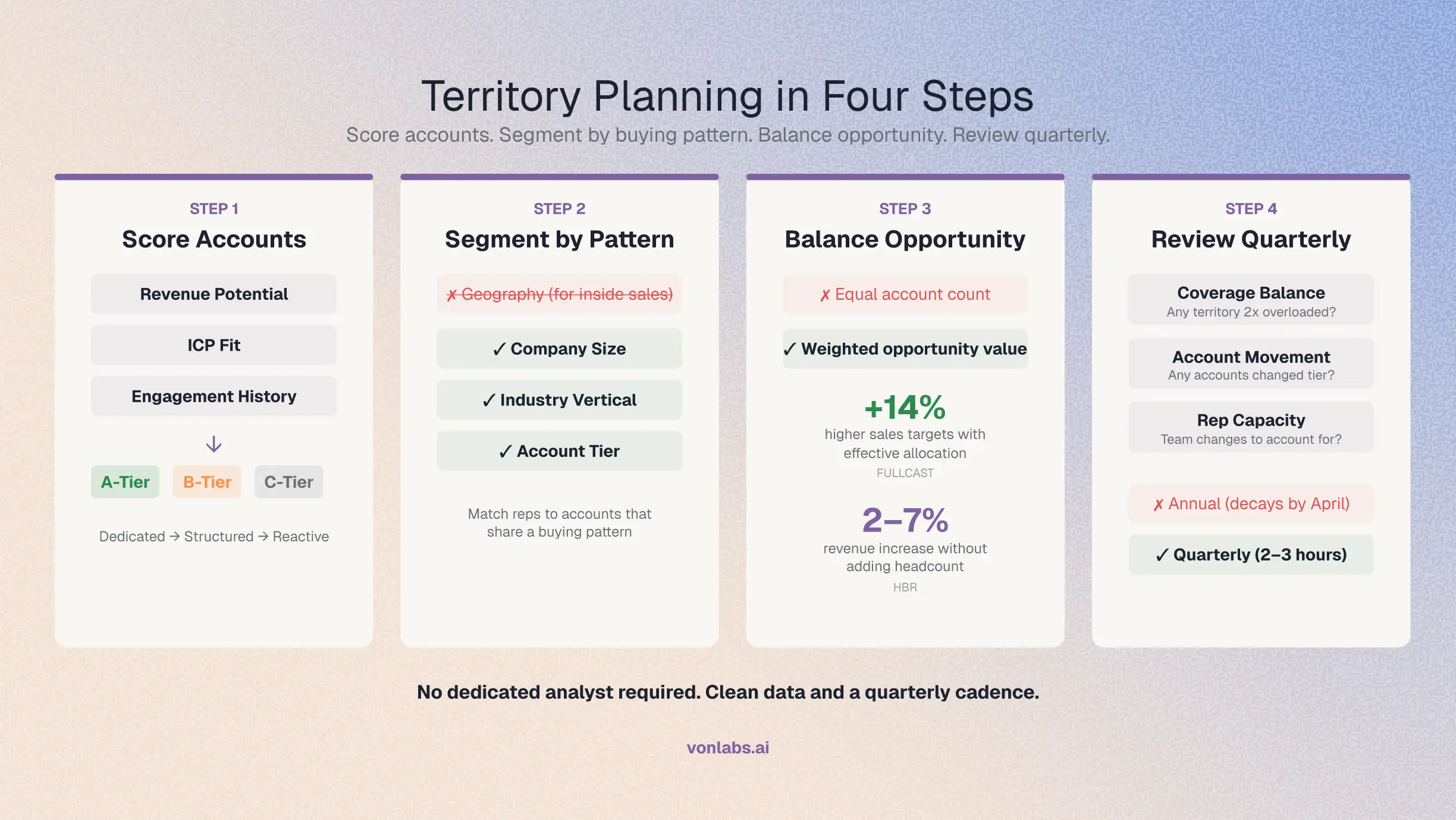
According to Harvard Business Review research cited by Xactly, optimized territory planning increases revenue by 2–7% without adding headcount. Yet most B2B SaaS companies under 200 employees don’t have a dedicated territory planning analyst. The work falls to a RevOps leader who is also running pipeline reviews, building forecasts, and maintaining the CRM.
The result: territories get set once a year in a spreadsheet, never revisited, and slowly drift out of alignment with the market. Reps work overlapping accounts. High-potential segments go uncovered. And when someone leaves, the territory map breaks.
Here is a four-step framework for building a territory plan that stays current — without hiring a dedicated analyst to maintain it.
Step 1: Score Your Accounts Before You Draw Lines
Most territory plans start with geography or alphabetical account assignment. Both are arbitrary. Start with account scoring instead.
Score every account on three dimensions:
Combine these into a simple A/B/C tier. A-tier accounts get the most coverage (dedicated rep, proactive outreach). B-tier accounts get structured coverage (regular cadence, shared ownership). C-tier accounts get reactive coverage (inbound only, pooled).
This scoring replaces the annual spreadsheet exercise. It can be refreshed quarterly with updated CRM data and engagement signals.
Step 2: Segment by Buying Pattern, Not Geography
Geography made sense when reps traveled to accounts. For inside sales teams selling SaaS, it creates artificial constraints. A rep assigned to the Northeast has no structural advantage over a rep assigned to the Southeast — both are selling over Zoom.
Segment by the dimensions that predict buying behavior:
Company size. A rep who sells to 50-person startups uses a different motion than one selling to 500-person enterprises. The discovery questions, the buying committee, the sales cycle length, and the pricing all differ.
Industry vertical. A rep who understands fintech compliance requirements closes faster in fintech than a generalist. Domain expertise compounds over time.
Account tier. A-tier accounts need a dedicated rep with deep engagement. C-tier accounts need a high-velocity rep who can work volume. Mixing both in one territory forces the rep to context-switch between enterprise and transactional motions.
The goal: every rep works accounts that share a buying pattern, so the rep can build expertise and repeatability in that motion.
Step 3: Balance Opportunity, Not Account Count
The most common territory planning mistake is balancing by account count. A rep with 50 A-tier accounts has a fundamentally different workload than a rep with 50 C-tier accounts. Equal account count does not mean equal opportunity.
Balance territories on weighted opportunity value:
Weighted value = (Number of A-tier accounts × average A-tier deal size) + (Number of B-tier accounts × average B-tier deal size) + (Number of C-tier accounts × average C-tier deal size)
Each rep should carry roughly the same weighted value. This means some reps will have fewer accounts (high-value, high-touch) and others will have more (lower-value, high-velocity). That is intentional — it matches the selling motion to the account profile.
Fullcast reports that companies using effective territory allocation achieve 14% higher sales targets on average. The difference is not the tool — it is the balancing methodology.
Step 4: Review Quarterly, Not Annually
An annual territory plan is a snapshot that decays the moment it is published. Reps leave. Accounts churn. New segments emerge. Market conditions shift. A plan set in January is misaligned by April.
Run a quarterly territory review that checks three things:
Coverage balance. Are any territories overloaded or underserved? Pull the weighted opportunity value per territory and compare. If one territory has 2x the weighted value of another, rebalance.
Account movement. Have any accounts changed tier? A C-tier account that raised a Series B and hired a VP of Sales is now a B-tier or A-tier. A former A-tier that churned is no longer in play. Update the scoring.
Rep capacity. Has the team changed? A new hire needs a ramp territory. A departing rep’s accounts need redistribution. A top performer might be ready for a higher-value territory.
This quarterly review takes 2–3 hours with clean data. Without clean data, it takes 2–3 days — which is why most teams skip it.
What Changes When the Data Is Automatic
The four steps above work with manual effort. But each step requires pulling data from multiple systems: CRM for account details and pipeline, the data warehouse for product usage, the call platform for engagement signals, and enrichment tools for firmographics. Assembling this data is the bottleneck — not the planning itself.
An intelligence layer like Von connects to all of these systems and can score accounts, model territory configurations, and surface rebalancing recommendations from a single prompt. The quarterly review that takes 2–3 days with spreadsheets takes 30 minutes when the data is already assembled and the scoring is automatic.
For more on how this fits into the broader RevOps workflow, see The AI VP of RevOps.
Frequently Asked Questions
How do you create a sales territory plan for a small team? Start with account scoring (revenue potential, ICP fit, engagement history), tier your accounts into A/B/C, and assign based on buying pattern rather than geography. For teams under 10 reps, a simple tiered model with quarterly reviews is more effective than complex territory mapping software.
How often should you revisit territory assignments? Quarterly. Annual territory plans decay within months as reps leave, accounts churn, and market conditions shift. A quarterly review that checks coverage balance, account movement, and rep capacity keeps territories aligned with reality.
Should SaaS companies use geographic territories? For inside sales teams, geography is rarely the right primary segmentation. Segment by company size, industry vertical, or account tier instead — these dimensions predict buying behavior better than location. Geography still matters for field sales teams where travel efficiency is a factor.
What is the difference between territory planning and territory management? Territory planning is the design phase: scoring accounts, defining segments, and assigning reps. Territory management is the ongoing operation: monitoring coverage, rebalancing when conditions change, and ensuring reps are working the right accounts. Most teams plan once and never manage — that is where territories break down.
How do you balance territories fairly? Balance on weighted opportunity value, not account count. Multiply the number of accounts in each tier by the average deal size for that tier. Each rep should carry roughly the same weighted value. This means some reps will have fewer high-value accounts and others will have more lower-value accounts — both are fair because the total opportunity is equal.
RevOps Playbook Series
- How to Run a Pipeline Review That Finds Real Risk
- How to Build a Sales Forecast That Leadership Trusts
- How to Build a QBR Deck in Minutes, Not Days
- How to Set Up Territory Planning Without a Dedicated Analyst
- How to Track Competitor Mentions Across Your Deal History
- How to Measure Rep Performance Beyond Quota Attainment
- How to Keep Your CRM Clean Without Policing Reps
- How to Prep for a Customer Call in 5 Minutes