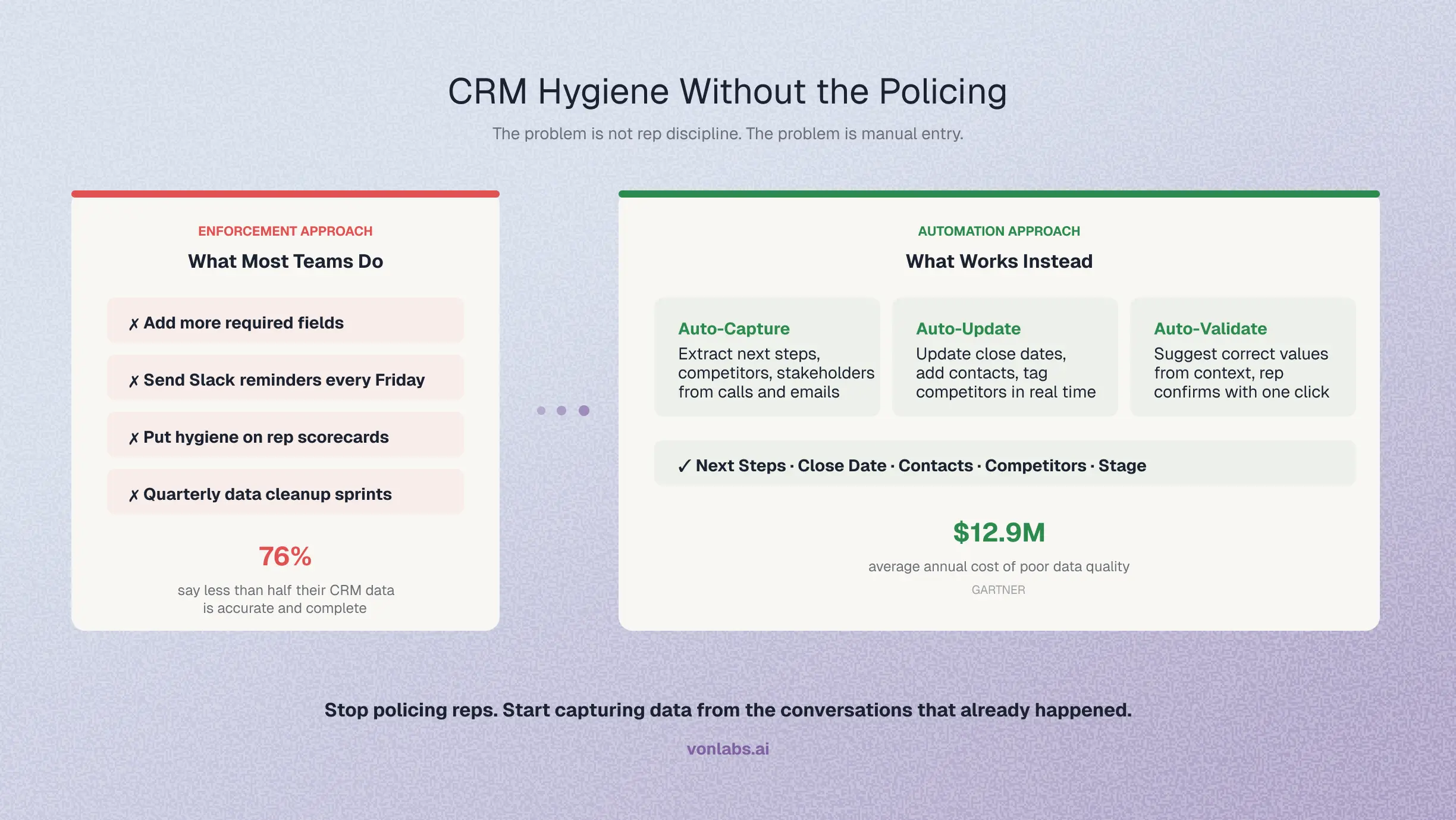
According to a 2026 survey by LinkPoint360 and Cyntexa, 76% of CRM users say less than half of their organization’s CRM data is accurate and complete. And 37% report losing revenue as a direct consequence.
The instinct is to enforce: add more required fields, send Slack reminders, put CRM hygiene on the rep scorecard. This approach fails because it treats the symptom (bad data) instead of the cause (manual entry). Reps are not lazy. They are busy selling. Asking them to be data entry clerks between calls is a structural problem, not a discipline problem.
Why Enforcement Does Not Work
Three reasons enforcement-based CRM hygiene fails:
Required fields create garbage data. When a rep is forced to fill in a field to save a record, they enter the fastest acceptable value. "TBD" in the next steps field. Today’s date as the close date. "Other" in the lead source dropdown. The field is populated. The data is useless.
Reminders create resentment. A Slack bot that pings reps to update their deals every Friday does not improve data quality. It trains reps to batch-update everything at once with minimal thought, and it erodes trust between RevOps and the sales team.
Scorecards penalize the wrong behavior. Putting CRM hygiene on a rep’s performance review conflates selling with data entry. The rep who closes the most revenue but has messy CRM data is more valuable than the rep with a pristine CRM and an empty pipeline.
What Clean CRM Data Requires
CRM data quality has four dimensions:
Enforcement addresses completeness (forcing fields to be filled) but does nothing for accuracy, timeliness, or consistency. A CRM where every field is populated but half the values are wrong is worse than a CRM with missing fields — because the wrong data looks right in reports.
The Alternative: Remove the Manual Entry
The highest-leverage fix for CRM hygiene is not better enforcement. It is reducing the amount of data that requires manual entry in the first place.
Auto-capture from conversations. Call recordings and email threads already contain next steps, competitor mentions, stakeholder names, and deal updates. Extracting these into CRM fields automatically eliminates the need for the rep to type them.
Auto-update from signals. When a close date is discussed on a call, update the CRM field. When a new stakeholder joins a meeting, add the contact. When a competitor is mentioned, tag the opportunity. These updates happen in real time, not on Friday afternoon.
Validation at the source. Instead of validating after the rep enters data, validate before: suggest the correct value based on conversation context and let the rep confirm with one click rather than typing from memory.
Gartner estimates that poor data quality costs organizations an average of $12.9 million per year. Most of that cost is downstream: bad forecasts, missed renewals, wasted outreach to wrong contacts. Fixing the data at the source — by capturing it automatically from conversations — is cheaper than cleaning it after the fact.
What to Automate First
Prioritize the fields that have the highest impact and the lowest manual compliance:
What Changes with an Intelligence Layer
An intelligence layer like Von connects to your call recorder, email, and CRM and writes structured data back into Salesforce automatically. After every call, it extracts next steps, updates close dates when timelines shift, adds new contacts from meeting attendees, and tags competitors mentioned in the conversation. The rep does not open Salesforce. The data is already there.
For more on why manual CRM entry is a structural problem, see CRM Data Entry Is Killing Rep Productivity.
Frequently Asked Questions
How do you improve CRM data quality without burdening reps? Automate data capture from conversations. Call recordings and emails already contain the information that belongs in CRM fields. Extracting it automatically removes the manual entry step that causes most data quality problems.
What is the cost of bad CRM data? Gartner estimates poor data quality costs organizations an average of $12.9 million per year. For sales teams specifically, the cost shows up in inaccurate forecasts, missed renewals, wasted outreach, and eroded trust in the CRM.
How often should you audit CRM data? Run automated hygiene continuously: deduplication, enrichment, and validation should operate in the background daily. Supplement with quarterly manual audits for mid-market teams. Larger databases or fast-moving sales teams may need monthly reviews.
Should CRM hygiene be on a rep scorecard? Measuring CRM hygiene as a rep performance metric conflates selling with data entry. Instead, measure the outcomes that clean data enables: forecast accuracy, pipeline visibility, and deal progression. If the data is captured automatically, the hygiene metric becomes irrelevant.
What CRM fields should be automated first? Start with the fields that have the highest downstream impact and the lowest manual compliance: next steps, close date, contacts and stakeholders, competitor mentions, and stage progression. These fields drive forecasting, pipeline reporting, and competitive intelligence.
RevOps Playbook Series
- How to Run a Pipeline Review That Finds Real Risk
- How to Build a Sales Forecast That Leadership Trusts
- How to Build a QBR Deck in Minutes, Not Days
- How to Set Up Territory Planning Without a Dedicated Analyst
- How to Track Competitor Mentions Across Your Deal History
- How to Measure Rep Performance Beyond Quota Attainment
- How to Keep Your CRM Clean Without Policing Reps
- How to Prep for a Customer Call in 5 Minutes