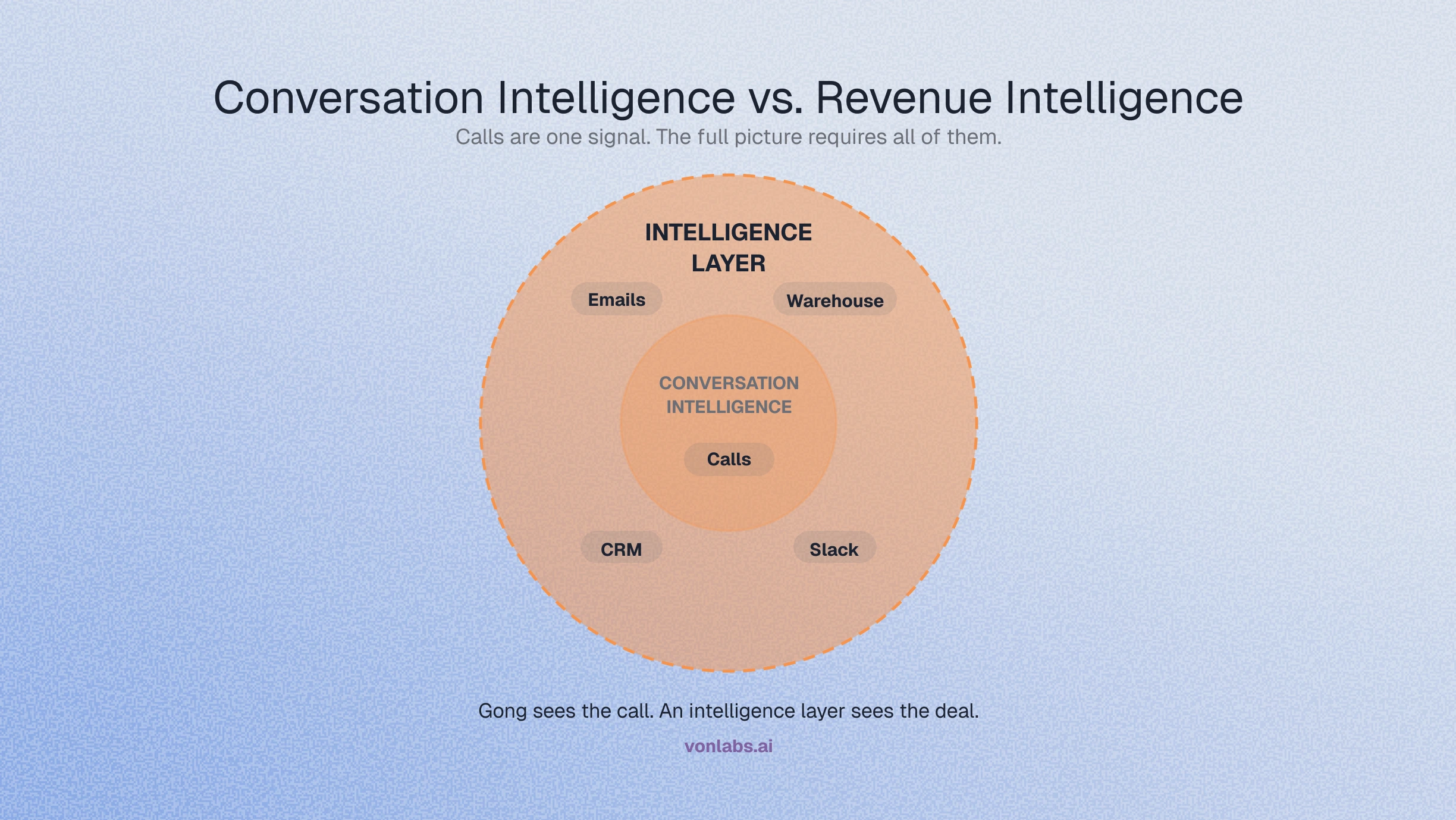
Gong defined the conversation intelligence category. It showed revenue teams that call recordings contain more truth about deals than CRM fields do, and it built a business around surfacing that truth at scale. For post-call analytics, coaching, and deal intelligence drawn from conversations, Gong remains the category leader.
But conversation intelligence is one layer of the revenue stack. Calls are one data source. And teams that started with Gong are increasingly asking whether they need a broader platform that reasons across calls, CRM data, emails, and their data warehouse simultaneously.
What Gong Does Well
Gong’s strengths are real and well-earned:
- Call recording and transcription at enterprise scale
- Post-call analytics: talk ratios, questions asked, competitor mentions, objection tracking
- Deal intelligence drawn from conversation patterns
- Coaching workflows: snippet sharing, scorecard benchmarking, call libraries
- Forecasting models built on conversation signals
For teams whose primary need is understanding what happens on calls, Gong is strong. The question is whether calls are the only data source that matters.
Where Teams Outgrow Gong
Calls Are One Signal Among Many
A deal’s health depends on more than what was said on the last call. It depends on CRM stage progression, email responsiveness, stakeholder count, close date movement, and product usage data. Gong sees the call. It doesn’t see the email thread where the champion went dark, the CRM field that hasn’t been updated in three weeks, or the product usage data showing declining engagement. (For more on why this matters for forecasting, see Why Your Sales Forecast Is Wrong.)
Gong Tells You What Happened, Not What to Do About It
Gong’s analytics surface patterns: which topics came up, how long the rep talked, whether the competitor was mentioned. But it doesn’t connect those patterns to the CRM data, build the forecast narrative, generate the QBR deck, or update the Salesforce fields. The insight stops at the dashboard. Someone on the RevOps team still has to reconcile what Gong says with what Salesforce says and what the email thread says.
Pricing Scales with Headcount, Not Value
Gong’s per-seat pricing ($1,200–1,500/user/year for mid-market teams, with multi-year contracts) means the cost scales linearly with team size. For a 25-person sales team, that’s $30,000–37,500/year for conversation intelligence alone. Teams running Gong plus Clari plus a data orchestration tool are paying for three platforms that each see a slice of the picture.
This Isn’t a Gong-Only Problem
Gong isn’t the only conversation intelligence platform facing this scope question. Chorus (now part of ZoomInfo) integrates deeply with ZoomInfo’s contact database but shares the same call-only view. Fathom is popular with smaller teams for its free tier and clean UX, but it’s a meeting notetaker — not a revenue intelligence platform. Avoma combines meeting intelligence with methodology scoring (MEDDIC, BANT) at mid-market pricing. Revenue.io is the only Salesforce-native option with real-time in-call coaching.
Each has its own strengths. But they all share the same structural limitation: they analyze calls. They don’t analyze the CRM data, the email threads, the Slack deal rooms, or the data warehouse. Switching from Gong to Chorus or Fathom solves a pricing problem or a feature preference. It doesn’t solve the scope problem.
Top Gong Alternatives Compared
What an Intelligence Layer Does Differently
An intelligence layer like Von doesn’t replace your call recorder. It sits on top of it — and on top of your CRM, your email, and your data warehouse — and reasons across all of them at once.
For a deeper comparison of how Gong, Clari, and Momentum fit together, see Gong vs. Clari vs. Momentum. For the full picture of what revenue intelligence includes, see What Is Revenue Intelligence?.
Frequently Asked Questions
Is Von a Gong replacement? Von is not a call recorder. It’s an intelligence layer that sits on top of your call recorder (Gong, Fathom, Chorus, or any other provider) and connects it with your CRM, email, and data warehouse. Some teams run Von alongside Gong. Others find that Von’s conversation analysis, combined with its broader capabilities, covers what they were using Gong for.
Can Von analyze call recordings like Gong does? Yes. Von ingests call recordings from your existing provider and reasons across them at scale — analyzing thousands of calls in a single query. The difference is that Von also cross-references those calls with CRM data, email activity, and data warehouse signals, so the analysis is grounded in the full deal context.
What are the main limitations of Gong? Gong’s primary limitation is scope. It excels at conversation intelligence but doesn’t analyze email content, CRM field progression, or product usage data. Teams that need cross-system intelligence — connecting what was said on a call with what the CRM shows and what the email thread reveals — need a broader platform. Gong’s per-seat pricing ($1,200–1,500/user/year) can also be a factor for mid-market teams.
What are other Gong alternatives? Chorus (ZoomInfo), Fathom, Avoma, and Revenue.io are conversation intelligence alternatives. Clari and Salesloft (now merged) offer forecasting with some conversation features. The question is whether you want another conversation intelligence tool or an intelligence layer that reasons across your entire revenue stack.
Is Fathom a good Gong alternative? Fathom is a strong option for teams that need meeting notes and call transcription at a lower price point. It’s popular with individual reps and smaller teams. The limitation is the same as Gong’s: it sees calls, not the full deal picture. For teams that need cross-system intelligence, an intelligence layer like Von covers what Fathom does and connects it with CRM, email, and warehouse data.
How is Chorus different from Gong? Chorus (now part of ZoomInfo) offers similar conversation intelligence capabilities to Gong, with deeper integration into ZoomInfo’s contact and intent data. The core limitation is the same: both analyze calls and meetings, but neither reasons across CRM data, email threads, or data warehouse signals.
What are the disadvantages of using Gong?
Gong's primary limitation is scope. It analyzes call recordings but does not process email threads, CRM field progression, product usage data, or data warehouse signals. Teams relying on Gong for deal intelligence are seeing only what was said on the call — not whether the deal is multi-threaded, whether the close date has been pushed, or whether product adoption supports the renewal. The second limitation is pricing: per-seat licensing at $1,200–1,500/user/year means costs scale linearly with team size, regardless of how much value each seat extracts.
Can one platform replace a Gong plus Clari stack?
Yes. An intelligence layer like Von connects to your call recorder, CRM, email, and data warehouse and reasons across all of them. It covers what Gong does (conversation analysis, coaching, deal intelligence from calls) and what Clari does (pipeline rollups, forecast accuracy, exec reporting) in a single platform — without requiring a RevOps analyst to reconcile what each tool says. Teams running both Gong and Clari are paying for two platforms that each see a slice of the picture. An intelligence layer sees the full deal.
Revenue Intelligence Series
- Gong vs. Clari vs. Momentum: Which Revenue Intelligence Platform Fits Your GTM Stack?
- What Is Revenue Intelligence? (And Why Point Solutions Only Solve Part of It)
- Why Your Sales Forecast Is Wrong: The Real Causes of Forecast Inaccuracy
- CRM Data Entry Is Killing Rep Productivity
- The AI VP of RevOps: What This New Role Means
- Deal Risk Detection: Catching At-Risk Deals Early
- Clari Alternative in 2026: Why Teams Are Switching
- Gong Alternative: When Call Recording Isn't Enough
- Momentum + Salesforce: What It Means for GTM Teams
- Agentic AI for Revenue Teams: What It Is