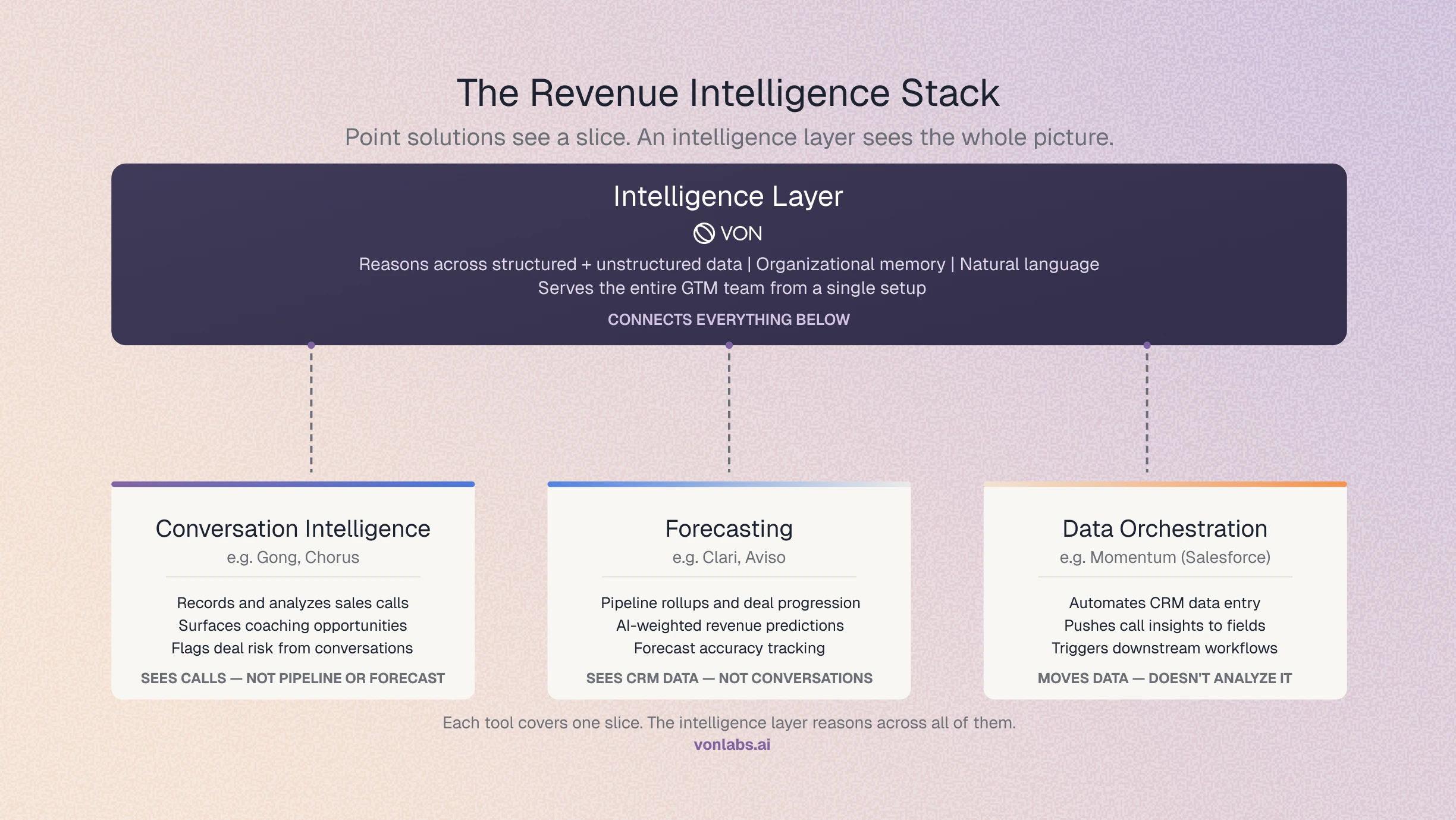
Revenue intelligence is the practice of using AI to capture, analyze, and act on the signals that drive revenue — sales conversations, CRM data, pipeline activity, email threads, and buyer behavior — so revenue teams can make faster, better-informed decisions. It emerged from the convergence of three older categories: conversation intelligence (recording and analyzing calls), sales analytics (reporting on pipeline and activity data), and forecasting tools (predicting revenue outcomes).
The term gets used loosely. Gong calls itself a revenue intelligence platform. So does Clari. So does Salesforce. But they’re solving different problems, and none of them covers the full picture on its own. This post breaks down what revenue intelligence includes, where the category is headed, and why most teams still have a disconnect between the intelligence they collect and the decisions they need to make.
What Revenue Intelligence Includes
Revenue intelligence isn’t a single product — it’s a set of capabilities that span the entire revenue workflow. Most platforms cover one or two of these well and leave the rest to other tools or manual work.
Conversation Intelligence
Recording, transcribing, and analyzing sales calls and meetings to surface what was said, how it was said, and what it means for the deal. This is where the category started — Gong and Chorus (now part of ZoomInfo) built the market around this capability. It answers questions like: What objections are coming up most? Is the champion still engaged? How much talk time did the rep use vs. the buyer?
For teams evaluating whether conversation intelligence alone is enough, see Best Gong Alternative in 2026: Beyond Call Recording.
Pipeline Intelligence
Analyzing CRM data, deal progression, and activity signals to assess pipeline health and flag at-risk deals. Clari built its business here — giving leadership a rollup view of where deals stand, which ones are slipping, and whether the pipeline supports the forecast. Backstory approaches this from the activity-capture side, automatically logging emails, meetings, and calls to fill the spaces reps leave in the CRM.
Forecast Intelligence
Using historical patterns and current signals to predict revenue outcomes with more accuracy than rep-submitted forecasts. This is where AI replaces gut feel — instead of asking reps "how confident are you?", the system evaluates deal velocity, stakeholder engagement, competitive presence, and dozens of other signals to generate a probability-weighted forecast.
Revenue Data Orchestration
Automating the flow of revenue-relevant data between systems — capturing insights from calls and emails and pushing structured data into CRM fields, Slack channels, or downstream workflows. Momentum (acquired by Salesforce in 2026) was the leader here, bridging the disconnect between what happens in a conversation and what gets logged.
Buyer Intelligence
Understanding who’s involved in a deal, how engaged they are, and what they care about. This includes multi-threading analysis (how many stakeholders are active), sentiment tracking, and relationship mapping. It’s the least mature sub-category — most platforms surface some of this, but few do it comprehensively.
How the Category Evolved
Revenue intelligence didn’t start as a category. It started as a feature.
In 2015, Gong launched with a simple premise: record sales calls and use AI to tell you what happened. That was conversation intelligence — a narrow, high-value capability that gave managers visibility into calls they couldn’t attend and gave reps feedback they’d never otherwise get.
Clari, founded in 2013, took a different angle: pull CRM and activity data together to give leadership a trustworthy view of the forecast. It focused entirely on structured data — pipeline rollups, deal progression, and forecast accuracy — without touching call recordings.
For years, these were separate markets. Conversation intelligence was one budget line; forecasting was another. Then two things happened.
First, Gartner formalized the convergence. In December 2025, Gartner published its first-ever Magic Quadrant for Revenue Action Orchestration, acknowledging that conversation intelligence, sales engagement, and forecasting were merging into a single category. The report named Gong and Clari as Leaders, alongside Outreach and others.
Second, the vendors started merging too. Clari and Salesloft completed their merger in December 2025, combining forecasting with sales engagement. Salesforce acquired Momentum in early 2026, folding data orchestration into Agentforce. The point-solution era is ending — but what’s replacing it isn’t a single tool. It’s a layer.
Revenue Intelligence Tools Compared
For a fuller shortlist, including Salesforce Revenue Intelligence, Revenue.io, Aviso and Backstory, see Best Revenue Intelligence Platforms in 2026.
The Disconnect Point Solutions Leave Behind
Here’s the problem with the current revenue intelligence landscape: every tool sees a slice of the picture, but no single tool sees the whole thing.
The result is predictable: teams buy three or four tools, each excellent at its job, and then a RevOps analyst spends 20 hours a week reconciling what each one says. The conversation intelligence tool says the deal is at risk because the champion went dark. The forecasting tool says the deal is on track because the close date hasn’t slipped. The CRM says the deal is in “Negotiation” because a rep updated the stage last Tuesday. Which one is right?
The answer usually requires a human to pull up the call recording, cross-reference it with the CRM history, check the email thread, and make a judgment call. That’s not intelligence — that’s manual labor dressed up as a tech stack.
What Complete Revenue Intelligence Looks Like
If you take the five capabilities above — conversation intelligence, pipeline intelligence, forecast intelligence, data orchestration, and buyer intelligence — and ask what it would take to unify them, you don’t get another point solution. You get an intelligence layer.
An intelligence layer sits on top of your existing tools rather than replacing them. It connects to your CRM, your call recorder, your email, your data warehouse, and your engagement platforms. Then it reasons across all of them — structured and unstructured data together — to answer questions that no single tool can.
Questions like:
- "Why are we losing deals in EMEA this quarter?" — requires cross-referencing call transcripts, CRM stage history, and pipeline data simultaneously.
- "Which deals in my forecast are at risk?" — requires reading the calls, not just the CRM fields.
- "What objections are coming up most in competitive deals?" — requires analyzing hundreds of calls, not just the five a manager can listen to.
- "Is our messaging landing differently by segment?" — requires connecting conversation patterns to deal outcomes across the full pipeline.
This is the problem Von is built to solve. Von connects to your entire revenue tech stack and spends its first few days autonomously building a context graph of your business — your pipeline stages, revenue definitions, win/loss patterns, org structure, and the full history of every deal. From there, it reasons across structured data (CRM, data warehouse) and unstructured data (calls, emails, documents) at scale. It can analyze thousands of calls in a single query, not just the handful that fit in a token window.
Revenue definitions only work when they are specific enough to govern the metric. For example, a sales win rate can mean closed-won deals divided by closed deals, qualified opportunities, or every opportunity created. See How to Calculate Sales Win Rate for the formulas, tradeoffs, and definition template.
The difference isn’t just breadth — it’s depth. Von builds organizational memory: your churn definitions, your fiscal calendar, your competitor field mappings, your team’s terminology. When one user corrects it, that correction applies to everyone. Over time, it behaves less like a tool and more like a tenured VP of RevOps who already knows how your business works.
Take a deeper look at the architecture behind this, or see the build-vs-buy math.
The Intelligence Layer vs. the Point Solution: A Side-by-Side
Frequently Asked Questions
What is revenue intelligence? Revenue intelligence is the practice of using AI to capture, analyze, and act on the signals that drive revenue — sales conversations, CRM data, pipeline activity, and buyer behavior — so revenue teams can make faster, better-informed decisions.
What’s the difference between revenue intelligence and conversation intelligence? Conversation intelligence is one component of revenue intelligence. It focuses specifically on analyzing sales calls and meetings. Revenue intelligence is broader — it also includes pipeline analysis, forecasting, data orchestration, and buyer intelligence. Most conversation intelligence tools (like Gong) have expanded into adjacent capabilities, but the full revenue intelligence picture requires connecting structured data (CRM, pipeline) with unstructured data (calls, emails) across the entire revenue workflow.
Is revenue intelligence the same as revenue operations? Revenue operations (RevOps) is a function — the team responsible for aligning sales, marketing, and customer success around shared revenue goals. Revenue intelligence is a category of technology that RevOps teams use to do their jobs. Think of RevOps as the role and revenue intelligence as one of the tools in their toolkit.
What is Gartner’s Revenue Action Orchestration category? In December 2025, Gartner published its first-ever Magic Quadrant for Revenue Action Orchestration, formalizing the convergence of conversation intelligence, sales engagement, and forecasting into a single category. It signals that the market is moving from point solutions toward unified platforms — though the Gartner category focuses primarily on sales execution and engagement, not the broader intelligence layer that connects structured and unstructured data across the full revenue workflow.
Do I need a revenue intelligence platform? If your team has multiple reps, a forecast someone depends on, and deals that die for reasons nobody can name until the post-mortem — yes. The question is whether you need a point solution for one capability (conversation analysis, forecasting) or an intelligence layer that reasons across all of them. The answer depends on how much time your team currently spends reconciling insights from different tools.
Can I build revenue intelligence with ChatGPT or Claude? You can get started — connecting a CRM to a general-purpose AI tool will answer basic questions. But you’ll hit walls fast: token limits that prevent analyzing more than a handful of calls, no persistent memory of your business definitions, and no way to scale it across a team without each user setting up their own connections. Purpose-built intelligence layers like Von solve these problems by pre-processing and vectorizing data at scale, building organizational memory, and serving the entire GTM team from a single setup.
How does revenue intelligence differ from conversation intelligence?
Conversation intelligence records and analyzes sales calls — talk ratios, competitor mentions, objection tracking, and coaching scorecards. Revenue intelligence is the broader category that includes conversation intelligence alongside pipeline analytics, forecast modeling, data orchestration, and buyer engagement signals. A conversation intelligence tool like Gong sees what was said on the call. A revenue intelligence platform connects that call data with CRM fields, email threads, and product usage to see the full deal.
What are the best revenue intelligence tools in 2026?
The major revenue intelligence tools serve different parts of the stack. Gong leads in conversation intelligence. Clari (now merged with Salesloft) leads in forecast rollups. Backstory focuses on activity capture. Momentum (now part of Salesforce Agentforce) handled data orchestration. Each covers one or two capabilities well. Von takes a different approach as an intelligence layer — it connects to your call recorder, CRM, email, and data warehouse and reasons across all of them, covering the full revenue intelligence picture from a single platform. For a side-by-side comparison of seven platforms by origin, strength and typical buyer, see Best Revenue Intelligence Platforms in 2026.
Revenue Intelligence Series
- Gong vs. Clari vs. Momentum: Which Revenue Intelligence Platform Fits Your GTM Stack?
- What Is Revenue Intelligence? (And Why Point Solutions Only Solve Part of It)
- Why Your Sales Forecast Is Wrong: The Real Causes of Forecast Inaccuracy
- CRM Data Entry Is Killing Rep Productivity
- The AI VP of RevOps: What This New Role Means
- Deal Risk Detection: Catching At-Risk Deals Early
- Clari Alternative in 2026: Why Teams Are Switching
- Gong Alternative: When Call Recording Isn't Enough
- Momentum + Salesforce: What It Means for GTM Teams
- Agentic AI for Revenue Teams: What It Is