Revenue intelligence is now a label that several different kinds of product share. One platform records and analyzes sales calls. Another forecasts pipeline from CRM data. A third captures activity automatically so the CRM stays current. They are all marketed as revenue intelligence, and they solve different problems.
That makes the shortlist harder to build than it looks. Two platforms can both be correct answers to "which revenue intelligence platform should we buy?" and still be wrong for your team, because the question underneath is which part of the revenue picture you are trying to see.
This comparison covers the leading platforms, what each one says it is built to do, and the buying situation each one fits.
How to Read This Category
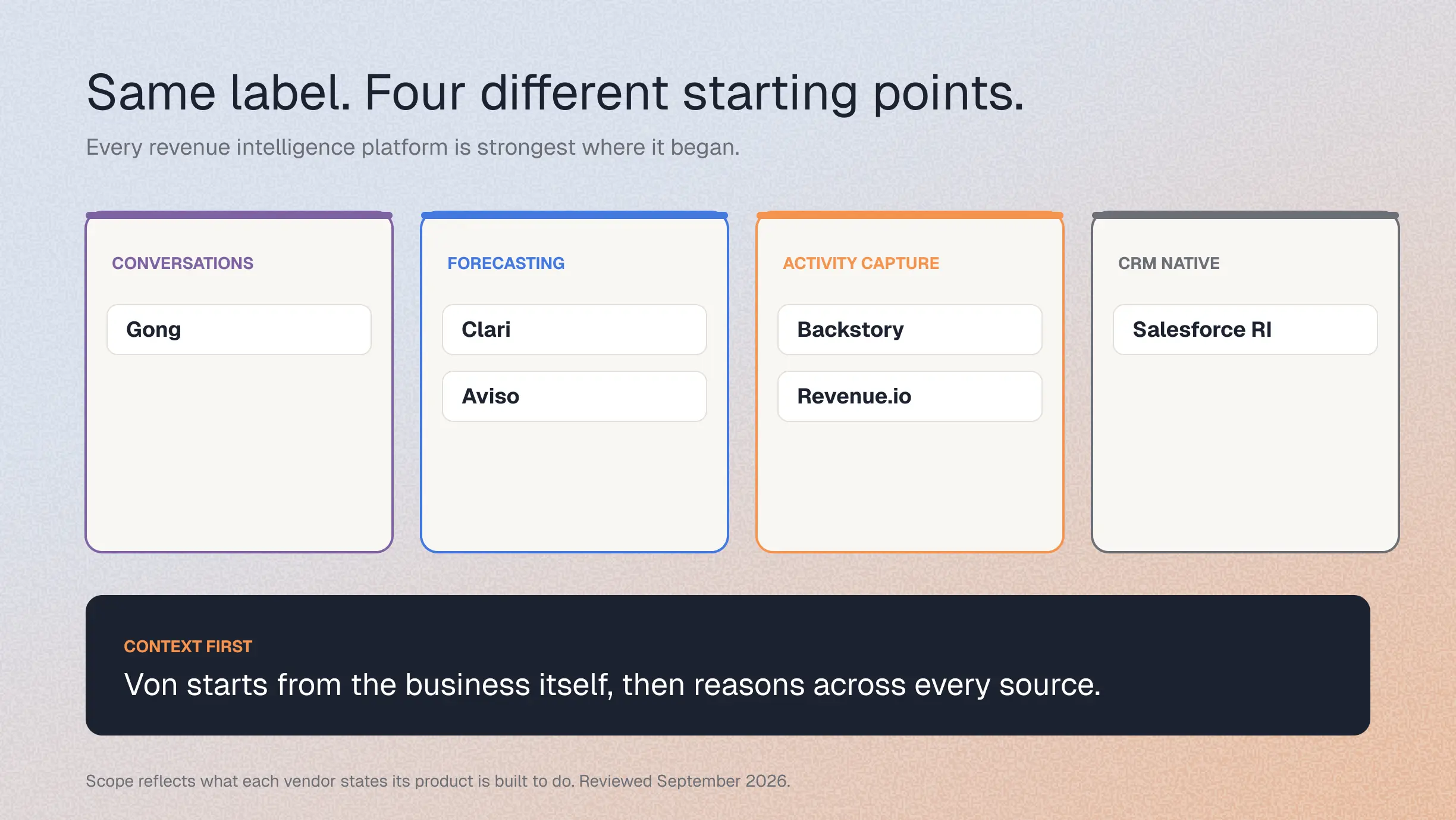
Most revenue intelligence platforms started in one of four places, and their origin still shapes what they are best at today.
Conversation-first platforms began by recording and analyzing calls. Forecast-first platforms began with CRM and pipeline data. Activity-capture platforms began by logging emails and meetings so reps did not have to. CRM-native platforms began inside Salesforce and inherited its data model.
Knowing which origin a platform has tells you more about its strengths than any feature list. A platform built around conversations will read a call better than it reads a warehouse. A platform built around forecasting will roll up pipeline better than it reads a call. If you need the category definition before the shortlist, start with What Is Revenue Intelligence?.
The Platforms
Gong
Gong built the conversation intelligence market and remains its reference point. On its own revenue intelligence page, Gong describes these platforms as providing "comprehensive visibility into buyer relationships and engagement activity across all touchpoints," with AI-powered insights that help teams accelerate sales cycles and improve pipeline visibility.
The company has since expanded beyond call analysis into forecasting, and customers cite Gong Forecast as a live view of the number rather than a periodic snapshot.
Best for: teams whose primary question is what happens inside customer conversations, and who want coaching and deal intelligence derived from calls. For a closer head-to-head, see Gong vs. Clari vs. Momentum.
Clari
Clari now positions itself beyond forecasting alone. Its product overview describes Clari as "the first Revenue Orchestration Platform using AI and Revenue Context to unify data, orchestrate workflows, and guide actions."
The platform is organized into named products rather than one surface: Capture for activity data, Inspect for account and opportunity review, Forecast for the number, Copilot for conversation intelligence and coaching, Align for mutual action plans, Analyze for reporting, and Groove for engagement.
Best for: enterprise revenue teams whose center of gravity is the forecast and the pipeline review, and who want the surrounding workflow in the same platform.
Backstory, formerly People.ai
This one carries a name change worth knowing before you search for it. On April 15, 2026, People.ai announced it was becoming Backstory, describing the move as a shift "from data and analytics toward delivering actionable answers."
The company now calls itself a Revenue Answers Platform. By its own description, it ingests signals from across the revenue stack including emails, calls, meetings, CRM records, intent data, and news, then applies revenue-specific reasoning to determine whether momentum is breaking and where risk is building.
Its distinguishing choice is delivery. Rather than asking teams to work in a new interface, Backstory surfaces answers inside Salesforce, Slack, Microsoft Copilot, ChatGPT, and Claude, using open APIs and Model Context Protocol integration.
Best for: enterprise teams that want deal answers delivered into the tools they already use, particularly those already committed to an AI assistant.
Salesforce Revenue Intelligence
Salesforce sells Revenue Intelligence as a capability of Sales Cloud rather than a separate platform. Its page describes "actionable and purpose-built intelligence built into Sales Cloud," with out-of-the-box AI-powered visualizations covering pipeline, forecasting, and rep performance.
The analytics are embedded natively, and Salesforce states there are 50 or more native connectors for blending external data with Salesforce records. Pricing depends on your Sales Cloud edition, and Salesforce notes that some editions include Revenue Intelligence already.
Best for: organizations standardized on Sales Cloud that want stronger embedded analytics without introducing another vendor.
Revenue.io
Revenue.io is built to live inside Salesforce. It describes automatically logging every call, email, and meeting so the pipeline stays current, and it ships an AppExchange package that the company says delivers over 100 reports and dashboards using a single custom Salesforce field.
Its most distinctive capability is timing. Revenue.io surfaces AI-powered guidance during live calls rather than in post-call review, which is a different coaching model from platforms that analyze conversations afterward.
Best for: Salesforce-centric teams that want activity capture and in-the-moment coaching in one product.
Aviso
Aviso markets itself as an end-to-end AI revenue platform and leads with agentic workflows. Its site describes more than 30 out-of-the-box agentic workflows, task-based agents covering 50 or more revenue use cases, and a no-code GTM Agent Studio for building and deploying agents without engineering support.
Underneath the agents, Aviso covers the familiar ground: conversation intelligence, relationship intelligence, forecasting, pipeline inspection, coaching, and deal acceleration.
Best for: teams that want packaged agent workflows across roles from BDR through CRO rather than assembling automations themselves.
Von
Von is a GTM AI system of intelligence, built around a GTM brain rather than around a single data source. It connects to CRM, call recordings, email, and the data warehouse, then spends three to seven days autonomously building that GTM brain: pipeline stages, revenue definitions, sales methodology, team structure, and institutional knowledge.
That context is what the rest of the work runs on. Because the unstructured data is preprocessed and vectorized ahead of time, a single question can reason across thousands of calls alongside CRM and warehouse data rather than a sampled handful. Because the definitions are shared, a correction one person makes applies to everyone.
Best for: revenue teams whose hardest questions cross sources, and who need consistent answers across a whole organization rather than one persona.
Comparing the Platforms
The table below reflects what each vendor says its product is built to do. Scope is not a quality judgment, and a narrower scope is often the right purchase.
Scope reflects what each vendor states its product is built to do. Reviewed September 2026.
Choosing Between Them
The useful question is not which platform is best overall. It is which question you need answered most often.
If the question is what happened on the call, a conversation-first platform is the direct answer. If the question is whether the forecast is real, a forecast-first platform is built for it. If the question is why the CRM is empty, an activity-capture platform addresses the cause. If the question is whether everyone in the organization gets the same answer from the same data, that is a context problem rather than a feature problem.
Three checks are worth running before you shortlist.
First, name the data the answer depends on. If your hardest questions need calls and CRM and warehouse data together, a platform strong in one source will require you to reconcile the rest by hand.
Second, count the personas. Several platforms are excellent for one role and thin for the others. If you are buying for a CRO, a manager, an AE, and a CSM at once, ask how each of them uses it on a Tuesday.
Third, ask who owns the definitions. Every platform will report a win rate. The question is whether it reports your win rate, using the stage thresholds and revenue fields your team agreed on.
The Cost Nobody Prices
Buying two or three of these is common and often sensible. The cost that does not appear on any quote is reconciliation.
When a conversation platform says the deal is at risk because the champion went dark, the forecast platform says it is on track because the close date held, and the CRM says it is in negotiation because a rep updated the stage last week, someone has to decide which is right. That someone is usually a RevOps analyst, and the work is manual.
That is the case for evaluating scope rather than features. A platform that answers one question well is worth buying. Three platforms that each answer one question well still leave the reconciliation to you. Teams weighing an internal build instead should read The Hidden Cost of DIY Revenue Intelligence first.
Frequently Asked Questions
What is a revenue intelligence platform? It is software that uses AI to collect and analyze revenue data, such as sales conversations, CRM records, pipeline activity, and buyer engagement, so revenue teams can see what is happening and decide what to do next. The term covers several different product types.
What is the difference between revenue intelligence and conversation intelligence? Conversation intelligence analyzes sales calls and meetings. Revenue intelligence is broader and also covers pipeline analysis, forecasting, activity capture, and buyer engagement. Most conversation intelligence platforms have expanded into adjacent areas, which is why the terms are often used interchangeably.
Which revenue intelligence platform is best? There is no single answer, because the platforms are built around different data sources. The right choice depends on whether your hardest question is about conversations, forecast accuracy, CRM completeness, or consistency across the organization.
Do we need more than one revenue intelligence platform? Many teams run two or more. It works, and it carries a reconciliation cost when the platforms disagree about the same deal. Scope your evaluation around the questions you ask most often before assuming you need several.
Is People.ai still called People.ai? No. The company announced on April 15, 2026 that it was changing its name to Backstory, and now describes itself as a Revenue Answers Platform.
Sources
Gong, What is a Revenue Intelligence Platform?
Backstory, People.ai Becomes Backstory
Salesforce, Revenue Intelligence
Revenue.io, Revenue Intelligence for Salesforce