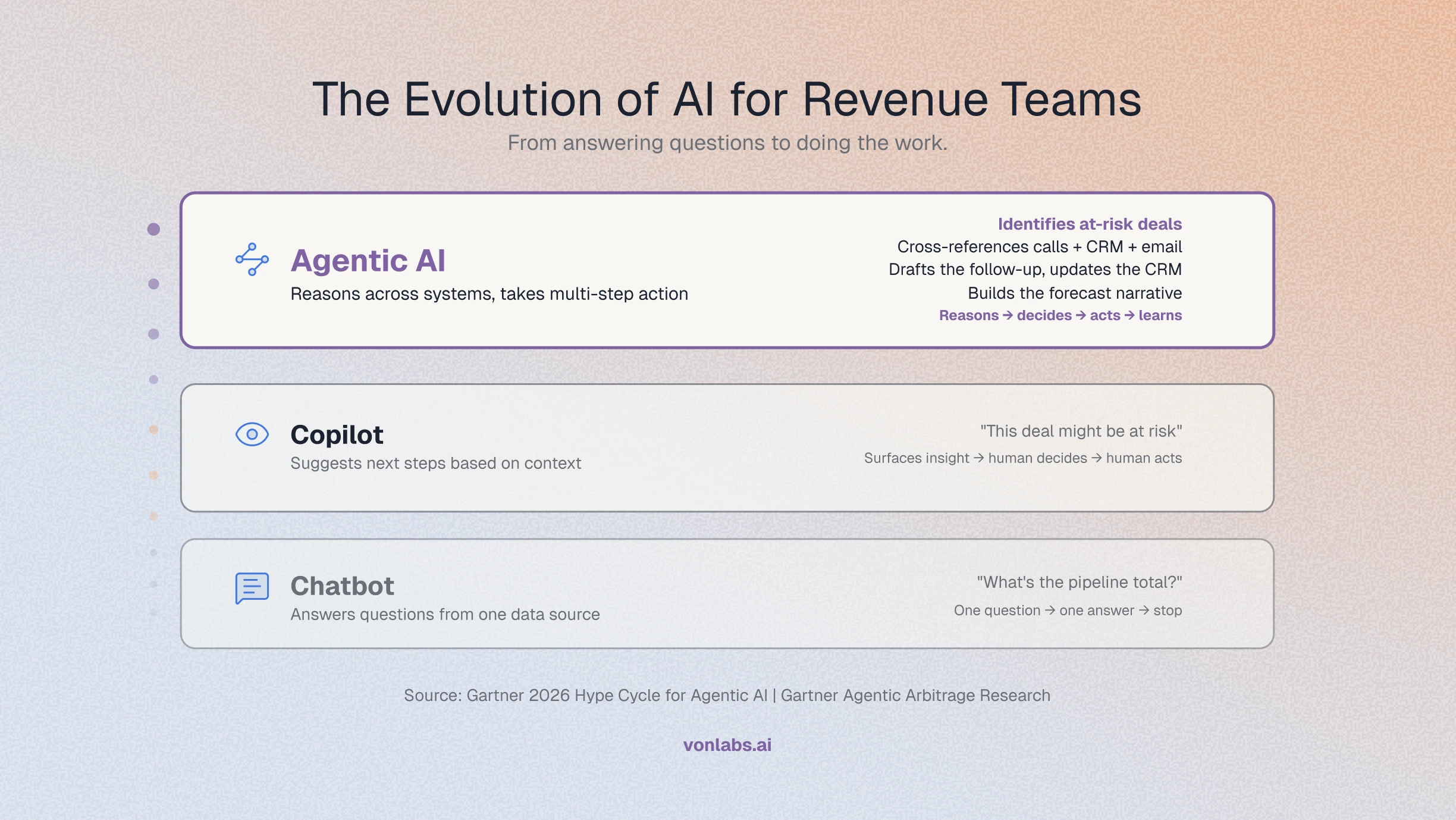
Agentic AI refers to AI systems that can reason, plan, and take autonomous action across multiple steps — without requiring a human prompt for each decision. Unlike chatbots that answer questions or copilots that suggest next steps, agentic AI executes workflows end-to-end: it gathers data from multiple systems, analyzes it, makes decisions, and takes action.
According to Gartner’s 2026 Hype Cycle for Agentic AI, only 17% of organizations have deployed AI agents to date, yet more than 60% expect to do so within the next two years — the most aggressive adoption curve of any emerging technology Gartner has measured.
For revenue teams, this shift is particularly significant. Sales, CS, and RevOps workflows are exactly the kind of multi-system, multi-step work that agentic AI is built to handle.
Why Revenue Teams Are the Natural Fit
Revenue operations sits at the intersection of structured data (CRM fields, pipeline stages, forecast categories) and unstructured data (call recordings, email threads, Slack conversations). Most RevOps work involves pulling data from multiple systems, reconciling it, and turning it into a decision or a deliverable.
This is the exact pattern agentic AI is designed for:
- A forecast narrative requires CRM pipeline data, call recordings from the past two weeks, and email activity — pulled from three systems, reconciled, and synthesized into a story.
- A deal risk assessment requires stage timing, contact engagement, call sentiment, and close date movement — signals scattered across Salesforce, Gong, and Outreach.
- A QBR deck requires account health data, product usage metrics, renewal status, and recent conversation highlights — assembled from a CRM, a data warehouse, and a call recorder.
Today, a RevOps analyst or a sales manager does this work manually. It takes hours. An agentic AI system does it in minutes — and it gets better over time because it learns the business. (For more on the time cost, see CRM Data Entry Is Killing Rep Productivity.)
Three Levels of AI for Revenue Teams
Not all AI is agentic. Understanding the difference matters because it determines what the system can do without human intervention:
The key difference is execution. A chatbot tells you the pipeline total. A copilot tells you which deals are at risk. An agentic AI identifies the at-risk deals, cross-references them with call recordings and email activity, drafts the follow-up, updates the CRM fields, and builds the forecast narrative — all before the pipeline review.
What Makes Agentic AI Work for Revenue Teams
Agentic AI for revenue teams requires three things that general-purpose AI platforms (Claude, ChatGPT) don’t provide out of the box:
1. Business context that compounds. An agentic system needs to understand your pipeline stages, your revenue definitions, your sales methodology, and your team structure. It needs to learn these once and apply them to every query — not re-learn them every session.
2. Cross-system reasoning. Revenue data lives in five or more systems. An agentic AI needs native connections to your CRM, call recorder, email, Slack, and data warehouse — and the ability to reason across all of them in a single query.
3. Action, not insight. The system needs to do the work, not describe the work. Update the CRM field. Build the deck. Draft the email. Generate the territory plan. The value of agentic AI is measured in hours saved, not dashboards viewed.
What to Look for in an Agentic Revenue Platform
An intelligence layer like Von is purpose-built for this. It connects to your CRM, call recordings, emails, Slack, and data warehouse, spends days autonomously learning your business, and then handles the multi-step work that RevOps teams spend 20+ hours a week on: pipeline analysis, forecast prep, deal risk detection, QBR decks, territory planning, and CRM administration.
Gartner estimates that $234 billion in enterprise software spending is exposed to agentic arbitrage by 2030 — the shift from per-seat SaaS tools to AI systems that complete tasks across multiple platforms. Revenue teams running Gong plus Clari plus a data orchestration tool are paying for three interfaces to data that an agentic layer can reason across in a single query.
For a deeper look at how this plays out in practice, see The AI VP of RevOps and Deal Risk Detection.
Frequently Asked Questions
What is agentic AI? Agentic AI refers to AI systems that can reason, plan, and take autonomous action across multiple steps without requiring a human prompt for each decision. Unlike chatbots or copilots, agentic AI executes workflows end-to-end: gathering data, analyzing it, making decisions, and taking action across multiple systems.
How is agentic AI different from a copilot? A copilot suggests what to do. Agentic AI does it. A copilot might flag that a deal is at risk based on stage timing. An agentic AI identifies the risk, cross-references it with call recordings and email activity, drafts the follow-up, and updates the CRM — all autonomously.
Why does agentic AI matter for revenue teams? Revenue operations involves pulling data from multiple systems (CRM, call recorder, email, data warehouse), reconciling it, and turning it into decisions or deliverables. This multi-system, multi-step pattern is exactly what agentic AI is designed to handle. Gartner’s 2026 Hype Cycle calls it the most aggressive adoption curve of any emerging technology.
What is an example of agentic AI for sales? An agentic AI for sales can identify at-risk deals by cross-referencing CRM stage timing with call sentiment and email responsiveness, then draft the follow-up email, update the Salesforce fields, and build the forecast narrative — all before the weekly pipeline review. This replaces hours of manual work across multiple tools.
Is Von an agentic AI platform? Yes. Von is an agentic AI platform built specifically for revenue teams. It connects to your CRM, call recordings, emails, Slack, and data warehouse, learns your business autonomously, and handles multi-step RevOps work: pipeline analysis, forecasting, deal risk detection, QBR decks, territory planning, coaching, and CRM administration.
Revenue Intelligence Series
- Gong vs. Clari vs. Momentum: Which Revenue Intelligence Platform Fits Your GTM Stack?
- What Is Revenue Intelligence? (And Why Point Solutions Only Solve Part of It)
- Why Your Sales Forecast Is Wrong: The Real Causes of Forecast Inaccuracy
- CRM Data Entry Is Killing Rep Productivity
- The AI VP of RevOps: What This New Role Means
- Deal Risk Detection: Catching At-Risk Deals Early
- Clari Alternative in 2026: Why Teams Are Switching
- Gong Alternative: When Call Recording Isn't Enough
- Momentum + Salesforce: What It Means for GTM Teams
- Agentic AI for Revenue Teams: What It Is