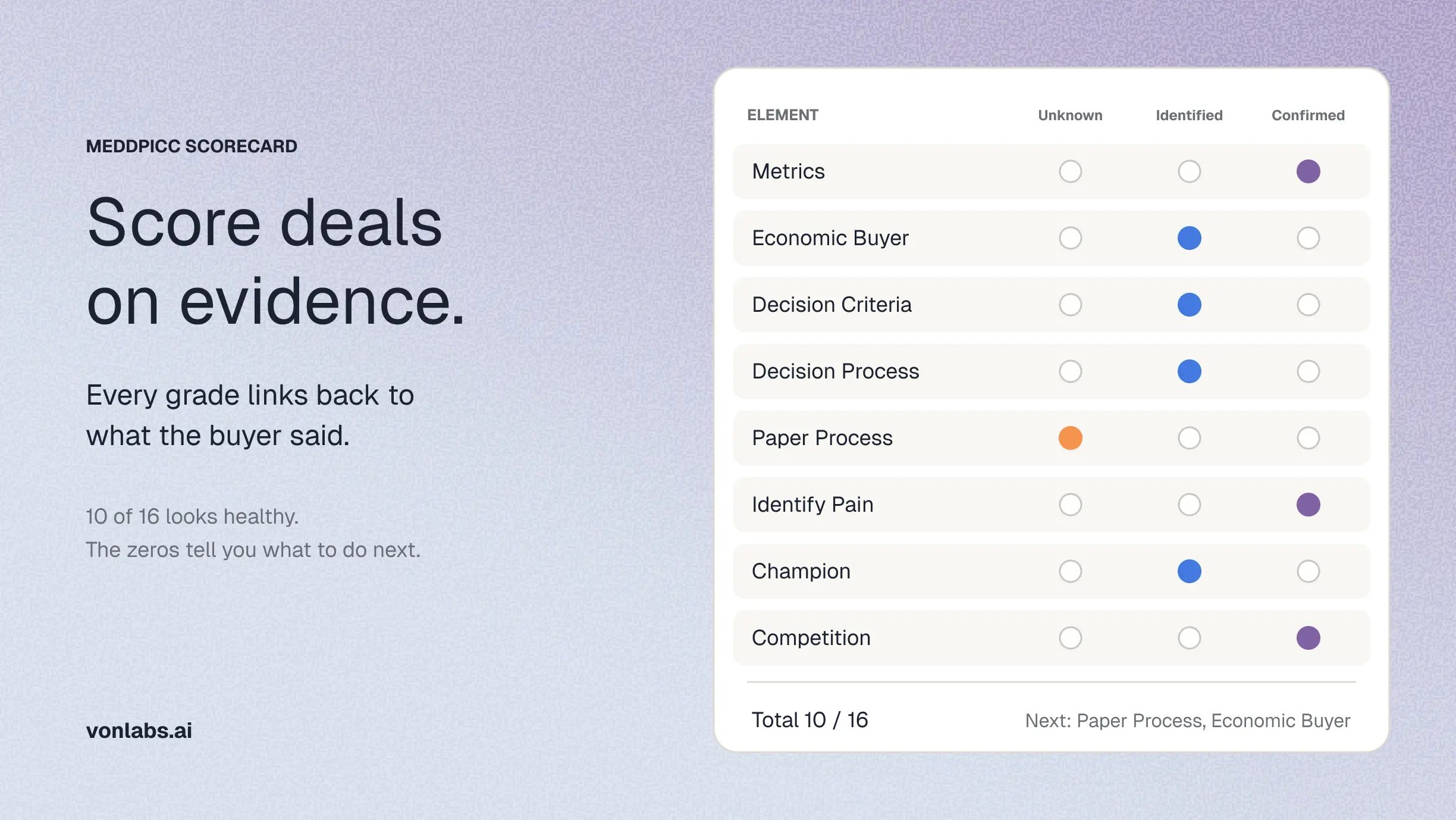
Most MEDDPICC scorecards fail for the same reason. The scores come from a rep's memory of the last call, and nobody can see what each score is based on. A deal shows a confirmed Economic Buyer because someone once mentioned the CFO, and the forecast call treats that as fact.
This guide gives you a MEDDPICC scorecard you can start using this week. It covers what each element means, a three-level scale, the evidence that earns each score, a worked example, and the habits that keep scores accurate after the deal review ends.
What MEDDPICC Stands For
MEDDPICC is a qualification framework for complex B2B sales. It grew out of MEDDIC, which MEDDICC traces to PTC in 1996 and credits to Dick Dunkel and Jack Napoli. The MEDDPICC program site, run by Darius Lahoutifard through MEDDIC Academy, lists the same eight elements:
Some versions call the I "Implicate the Pain" instead of "Identify Pain." The scoring approach in this guide works with either name.
MEDDIC vs MEDDPICC
MEDDIC is the original set of six elements. MEDDICC adds Competition. MEDDPICC also adds Paper Process, which matters most when legal, security, and procurement reviews can hold up a deal after the buyer has agreed in principle. If your deals tend to slip after a verbal yes, Paper Process is the element to watch.
The MEDDPICC Scorecard
A useful scorecard has two parts: a scale that everyone applies the same way, and a clear definition of the evidence that earns each level.
The scale
Eight elements at two points each gives a maximum of 16. Treat the total as a summary. The individual zeros matter more than the total, because each one names a specific question the deal has not answered yet.
What counts as confirmed
Three scoring rules
- Score what the buyer said or did. Your expectations about the deal do not count as evidence.
- Record the source for every 1 or 2. Note the call or email, the person, and the date.
- Lower a score when the evidence changes. If a champion leaves the company or a new security review appears, the score goes down that day.
A Worked Example
Here is a hypothetical mid-market deal, scored after the third call.
The total is 10 out of 16, which looks healthy. The detail says something different. The deal has a confirmed pain and a measurable goal, but nobody has spoken with the person who approves the budget, and nobody knows what happens after the buyer says yes. The next steps come straight from the scorecard:
- Ask the champion to set up a 20-minute call with the CFO before the pilot ends. This tests the champion and reaches the Economic Buyer at the same time.
- Ask who reviews vendor contracts and security questionnaires, and how long each review took on the last software purchase.
Why MEDDPICC Scorecards Stop Being Reliable
Many teams build a MEDDPICC scorecard when they adopt the framework. Keeping it accurate is harder, and scorecards tend to lose accuracy in four predictable ways.
Scores come from memory
Reps often fill in fields right before the forecast call, days after the conversation. Details get rounded up, and "the CFO might be involved" becomes a confirmed Economic Buyer.
Scores only go up
Teams rarely lower a score when a champion stops responding or a new approver appears. Older deals end up looking stronger than they are.
Evidence is not attached
A field marked "Confirmed" without a source cannot be checked by a manager, and it is hard to challenge in a deal review.
Each person scores differently
One manager's "identified" is another manager's "confirmed." When the definitions live in people's heads, the same deal earns different scores depending on who reviews it. It is the same problem teams run into when AI gives different answers across a team: the inputs are similar, but the definitions are not shared.
How to Keep a MEDDPICC Scorecard Current
- Write the definitions down once. Put the scale and the evidence table in one shared place, and use them in every deal review.
- Score from the record. Use the call recording, notes, and emails from the conversation itself, rather than a recap written later. Reps who are already stretched by CRM data entry will skip this step unless it is easy.
- Rescore on new evidence and on a schedule. Update the scorecard after every buyer conversation. For open deals in the forecast, review every element at least once a month and lower any score whose evidence is out of date.
- Review the zeros first. In pipeline reviews, start with each deal's unknown elements and agree on one next step for each. Pair this with the early warning signs of deal risk.
- Connect the scorecard to the forecast. A deal in Commit with an unknown Economic Buyer or Paper Process deserves a question. Weak qualification is one of the reasons sales forecasts miss.
Where Von fits
These habits work, but they depend on someone reading every call and email for every open deal, every week. That is the work that falls behind first when a team gets busy.
Von is a GTM AI system of intelligence. Its GTM brain stores your team's definitions, including what counts as identified or confirmed for each MEDDPICC element, so every answer applies the same standard. Von reads your calls, emails, and CRM records. A manager preparing for a deal review can ask what the buyer said about the paper process, or whether anyone has spoken with the Economic Buyer, and get an answer drawn from the conversations themselves.
Teams can also set up AI fields in Von that score each MEDDPICC element on their opportunities from the deal's calls and emails. Each score comes with the reasoning behind it, and the scores are recalculated as new conversations come in.
Because everyone works from the same definitions, a rep, a manager, and a CRO who ask about the same deal get the same answer.
Frequently Asked Questions
Is there a MEDDPICC scorecard template I can use? You can use the scale and evidence tables in this guide as a template, either in a spreadsheet or as CRM fields. Create one field per element for the score and one for the evidence and its source.
How is MEDDPICC different from BANT? BANT covers Budget, Authority, Need, and Timing, and it suits early qualification of simpler deals. MEDDPICC adds how the decision gets made, the steps to a signature, who is championing the deal, and what it competes with. Some teams use BANT to qualify leads and switch to MEDDPICC once an opportunity is open.
How often should you update a MEDDPICC scorecard? Update it after every buyer conversation. For deals in the current forecast, review every element at least once a month so stale evidence does not carry a high score.
What score should a deal reach before it counts as qualified pipeline? Many teams set a minimum, such as a confirmed Pain and an identified Economic Buyer, before a deal counts as qualified. Whatever rule you choose, apply it consistently, because it changes your win rate and pipeline coverage calculations.
Can AI fill in MEDDPICC fields? AI can pull MEDDPICC evidence from calls and emails, which removes most of the manual entry. Before you rely on it, check two things: whether each grade links to the evidence behind it, and whether the AI applies your team's definition of each level.
Sources