The term GTM brain is quickly becoming shorthand for the system that gives AI an enduring understanding of how a company goes to market. That is a useful idea. It is also becoming a catch-all phrase for everything from a prompt library to a full operating system.
A prompt library, a folder of battle cards, and a few Claude skills connected to Salesforce can be useful. None creates a shared, current understanding of the business that works across people, systems, and workflows.
The Simple Definition
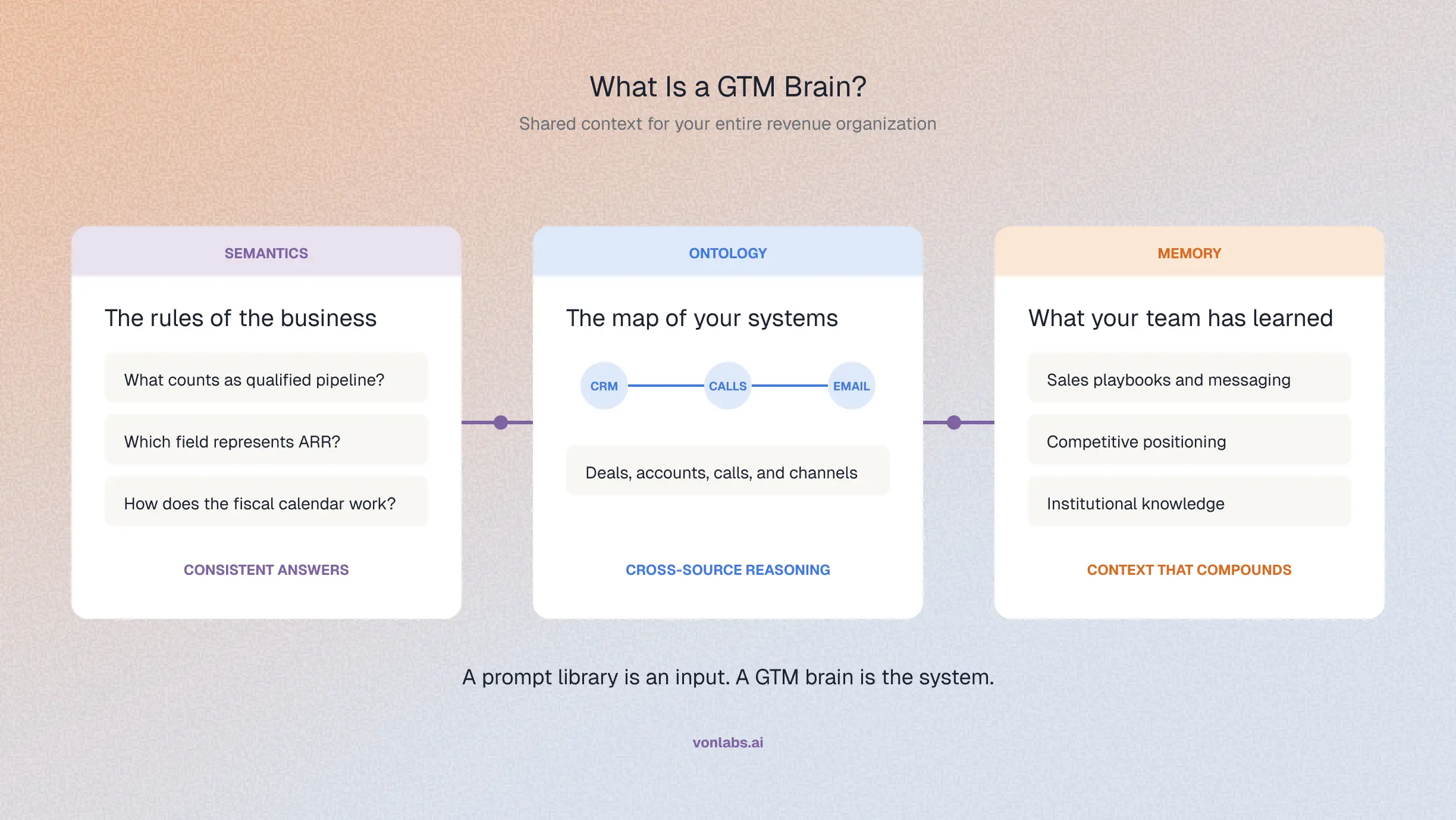
A GTM brain is a shared and persistent model of your go-to-market business. It combines the definitions your team relies on, the relationships between your data sources, and the institutional knowledge that lives in calls, playbooks, and experienced operators.
The point is to give people and AI workflows the same context. A sales manager, RevOps leader, and AE should not have to re-explain the fiscal calendar, sales stages, authoritative revenue field, or account hierarchy whenever they ask a question.
That distinction is reflected in the emerging category conversation. Attio describes a GTM brain as persistent context that gets smarter over time. Octave frames it as a context layer that carries GTM strategy across tools. The shared insight is that the model is only as useful as the context beneath it.
The Three Layers of a GTM Brain
1. Semantics: the definitions that keep answers consistent
Semantics are the business definitions that remove ambiguity: what counts as qualified pipeline, which field represents annual recurring revenue, what churn means, which deals belong in a forecast, and how the fiscal calendar works.
Without this layer, an AI can return a polished answer using the wrong field, deal type, or stage threshold. Semantics give the system a governed answer to questions that otherwise vary by person and prompt.
2. Ontology: the map of how your systems and records connect
Ontology is the relationship map. It explains that a Salesforce opportunity belongs to an account, that an account maps to a customer in the data warehouse, that a call belongs to a deal, and that a Slack channel is a deal room for a specific opportunity.
This is what lets a GTM brain answer cross-source questions. It can connect a CRM record to recent customer conversations, product usage, support history, and internal deal discussion instead of treating each system as a separate search box.
3. Memory: the institutional knowledge that does not live in fields
Memory holds the material that makes an organization specific: sales playbooks, messaging, competitive positioning, onboarding practices, pricing rules, and the decisions experienced operators carry in their heads.
The most important revenue questions are rarely only about structured data. Why did we lose? What objection is gaining traction? What should an AE emphasize in a renewal? The answer depends on what was said and what the organization has learned.
Why Skill Files Are Not a GTM Brain
Skill files are instructions. They tell an AI how to complete a task. A skill for account research might specify the sources to check, the questions to answer, and the output format. That is valuable, but it is only one component of a system.
The problem is that skills do not automatically resolve the context behind the instruction. A skill can say to calculate qualified pipeline, but it cannot by itself determine which opportunity field is authoritative, whether a stage changed last week, or which definitions a new RevOps leader approved yesterday. Someone has to write, update, distribute, and enforce those details.
The same is true of prompt libraries. They improve consistency when people use the right prompt. They do not make the underlying data consistent, connect records across systems, or ensure the answer reflects the latest institutional knowledge.
A GTM brain can use skills, prompts, and workflows. It is the layer that makes them reliable at team scale.
What a GTM Brain Makes Possible
Once the context is shared, teams can ask questions in normal business language without needing to know the exact field name, reporting logic, or source-system workaround. The work becomes more consistent because the system applies the same definitions for everyone.
It also changes the scope of questions an AI can handle. Instead of asking for a summary of one call, a leader can ask which renewal accounts show declining engagement across CRM activity, call transcripts, email, and product signals. Instead of manually assembling a forecast package, RevOps can ask for a review that applies the company’s agreed rules.
The difference is not only speed. It is repeatability. A GTM brain turns isolated answers into an operating capability that can be shared, improved, and governed.
Build It or Buy It?
Teams can build a GTM brain themselves with context files, skills, connectors, a vector database, data pipelines, permissions, and an interface. The hard part is making those ingredients one maintained system rather than a collection of experiments.
That means deciding who owns definitions, how updates propagate, how unstructured data is prepared, how access is scoped, how quality is evaluated, and how the system stays current as the business changes. The first prototype is usually the easy part. Team-wide reliability is the product work.
Von is built as a GTM system of intelligence around that problem. It connects structured and unstructured GTM sources, then autonomously builds a GTM brain over three to seven days: semantics for governed definitions, ontology for system relationships, and memory for institutional knowledge. The result is a shared context layer that supports analysis, CRM administration, forecasting, deal work, and reporting without requiring each person to assemble the context from scratch.
Frequently Asked Questions
What is a GTM brain? A GTM brain is a shared, persistent model of how a company goes to market. It combines business definitions, relationships between data sources, and institutional knowledge so people and AI workflows can work from the same context.
Is a GTM brain the same as a prompt library? No. A prompt library provides reusable instructions. A GTM brain provides the current business context that makes those instructions reliable, including definitions, data relationships, and organizational knowledge.
What are the main components of a GTM brain? The three core components are semantics, which govern business definitions; ontology, which maps system and record relationships; and memory, which stores playbooks, messaging, and other institutional knowledge.
Can I build a GTM brain with Claude or ChatGPT? You can assemble components with foundation models, context files, skills, and connectors. To make it work across a team, you also need shared definitions, data preparation, permissions, ongoing maintenance, and a way for corrections to propagate.
Why does a revenue team need a GTM brain? Revenue work spans CRM data, calls, email, internal communication, product signals, and company-specific rules. A GTM brain connects that context so the team can get more consistent answers and run cross-source work without rebuilding the context for every question.
AI for Revenue Teams: Build vs. Buy