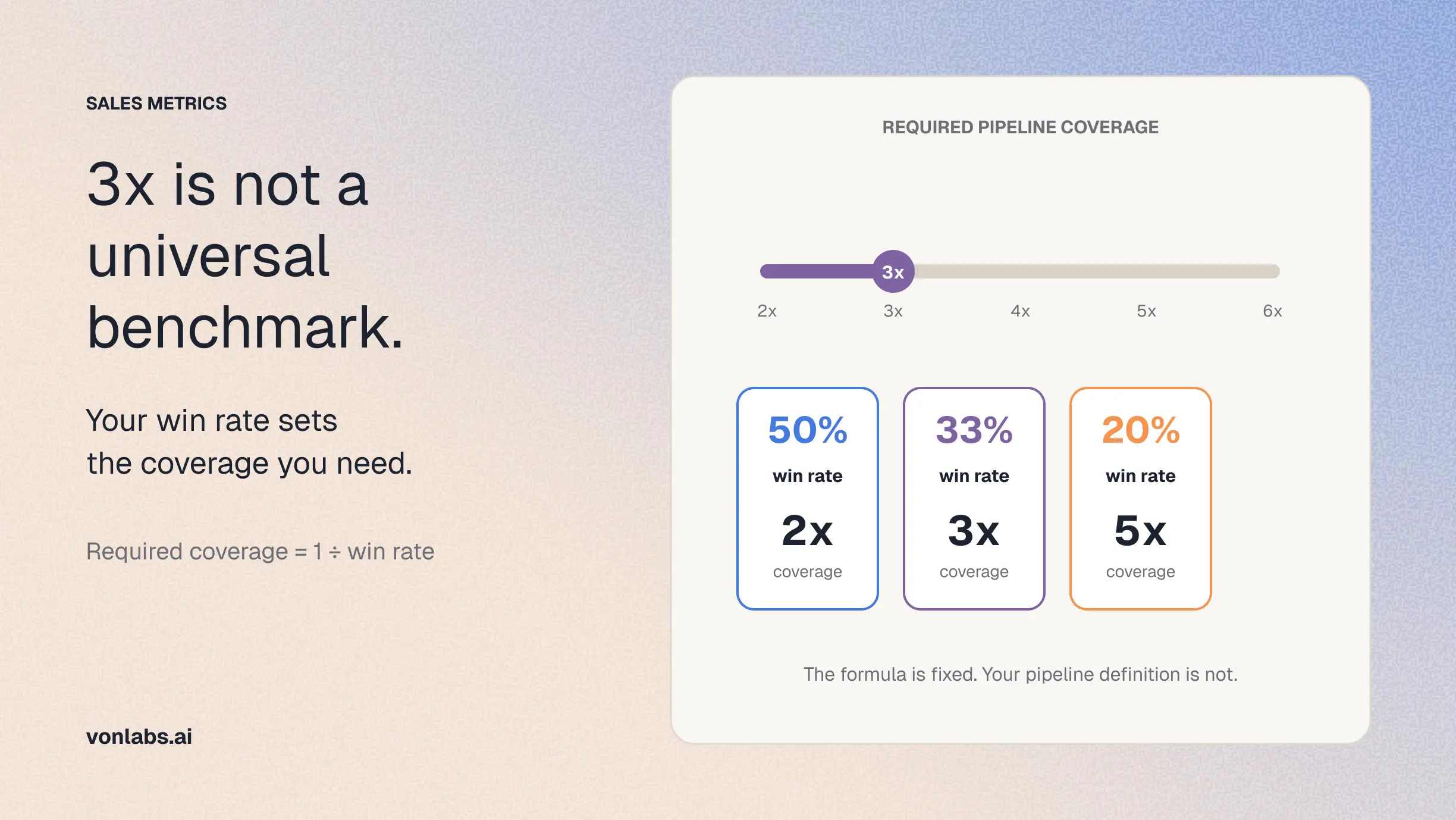
Pipeline coverage ratio answers one question: is there enough pipeline to hit the number? The formula takes one line. The hard parts are deciding which deals count as pipeline and knowing what ratio your team needs, because "3x" only works for teams that win about one deal in three.
This guide covers the formula, how to set your coverage target from your own win rate, and the definitions that decide whether the ratio means anything.
The pipeline coverage formula
Pipeline coverage ratio = Qualified pipeline value ÷ Revenue target for the same period
For example, $1.5M of qualified pipeline against a $500K quarterly target is 3x coverage. Clari, HubSpot and monday.com all use this same calculation.
Two conditions make the result meaningful. The pipeline and the target must cover the same period, and the pipeline must include only deals that meet your qualification bar.
Why 3x is not a universal benchmark
3x is the most quoted target, and HubSpot says most teams aim for 3:1 to 5:1. But the right ratio depends on how often your team wins. Clari and monday.com both give the same rule:
3x is exactly right only at a win rate of about 33%. A team with a 25% win rate and 3x coverage should expect about $375K against a $500K target, a 25% shortfall, even though its coverage looks healthy. That makes the win rate you plug in critical, and win rate has several valid definitions. Our guide to calculating sales win rate explains why the denominator matters.
Use a win rate calculated on the same population as your pipeline. If the pipeline counts qualified opportunities, the win rate should be measured on qualified opportunities too.
The formula is settled. What counts as pipeline is not.
The numerator is where most coverage numbers go wrong. Here is the same team against the same $500K target, with three different decisions about what belongs in the pipeline.
The same CRM can report anywhere from 2.2x to 4.8x. The higher figures look reassuring and are the least useful for a forecast.
1. Which deals are qualified
Clari defines qualified pipeline as opportunities with documented buying intent, an identified need, a timeline and active stakeholder engagement, not every open CRM record. Counting unqualified deals inflates the ratio without making the quarter any safer. Agree on the stage or criteria that make a deal count.
2. Which deals are stale
Old deals inflate coverage because they still carry value. Clari suggests discounting or removing deals that have been open more than twice your average sales cycle. A team reporting 4x coverage where 30% of the pipeline is stale has about 2.8x of qualified coverage.
3. Which period the pipeline covers
Count only deals with close dates in the same period as the target. A deal expected next quarter does not help this quarter. Teams with long sales cycles often track current-quarter and next-quarter coverage separately rather than blending them.
4. Which value field the pipeline uses
If your CRM has more than one amount field, decide which one represents pipeline value and which sales motions belong in it. New business, expansion and renewal pipeline convert at different rates, so they need separate coverage targets.
Calculate coverage by segment
A blended ratio hides the segments that are short. monday.com suggests 4:1 to 6:1 for enterprise, 3:1 to 4:1 for mid-market and 2:1 to 3:1 for SMB, because win rates and cycle lengths differ. The better approach is to calculate each segment's target from its own win rate, then measure its coverage against that target.
Coverage also works best next to velocity. A team with strong coverage but a slow cycle may not close those deals in time. Our guide to calculating sales velocity covers how cycle length and win rate combine.
Why coverage can look healthy and still miss
When a team reports 4x coverage and misses the quarter, the cause is usually in the pipeline, not the ratio: inflated deal values, close dates that keep slipping, stale deals, or a win rate lower than the target assumed. The same issues explain why sales forecasts go wrong.
This is where a GTM brain matters. Von is a GTM AI system of intelligence that holds the definitions behind the metric: which stage qualifies a deal, which field carries value, which motions are separate, which win rate sets the target, and when a deal counts as stale. Every report, dashboard and AI workflow then calculates coverage the same way, so the CRO and the RevOps lead see the same number.
A definition template for pipeline coverage
Write this down before you report the metric:
"Pipeline coverage for [segment and motion] is the value of opportunities at [qualifying stage or criteria] or later, using [value field], with close dates in [period], excluding deals open longer than [stale threshold], divided by the [period] target. Our coverage target is 1 ÷ [win rate definition]."
Frequently asked questions
What is a good pipeline coverage ratio? Most B2B teams target 3x to 5x, but the right ratio depends on your win rate. Divide 1 by your win rate: a 25% win rate needs 4x coverage, and a 40% win rate needs 2.5x.
How do you calculate pipeline coverage? Divide the value of qualified open opportunities expected to close in a period by the revenue target for that same period. $1.5M of qualified pipeline against a $500K target is 3x.
Is 3x pipeline coverage enough? It is enough if your team wins about one in three qualified deals. Teams with lower win rates need more, and teams with higher win rates need less.
Should pipeline coverage be weighted? Unweighted coverage shows volume. Weighted coverage multiplies each deal by its stage probability to estimate likely revenue. monday.com recommends tracking both. Weighted coverage is only as reliable as the stage probabilities behind it.
Why is my coverage high but I keep missing quota? Usually because the pipeline includes stale or unqualified deals, deal values are inflated, close dates are wrong, or your real win rate is lower than your coverage target assumes.
Sources
Clari: Pipeline Coverage Ratio: What Your Number Actually Means
HubSpot: Sales Pipeline Coverage
monday.com: What is sales pipeline coverage? Formula, examples, and ideal ratios