Most account plans are written once a year, presented in a review, and filed. The priorities listed in them often came from the account owner's memory of the last few calls, mixed with what the team hopes is true. By the next quarter, nobody can tell which parts came from the customer.
This guide gives you a free account plan template you can copy, a worked example, and one habit that keeps the plan useful: labeling every important point as confirmed by the customer, a hypothesis from your team, or an open question.
What Is an Account Plan?
An account plan is a working document that sets out your strategy for one customer or target account. It covers what the customer is trying to achieve, who matters in their organization, where you can help them further, what could put the relationship at risk, and the actions your team will take next.
An account plan is different from a mutual action plan. A mutual action plan lists the steps a buyer and seller agree to take to complete one purchase. An account plan covers the whole relationship across deals and over time, and it is usually an internal document.
Teams often call the plans for their most important customers a strategic account plan or a key account plan. The structure is the same. Those plans get more detail and more frequent review.
What a Good Account Plan Includes
- Account snapshot: what they buy from you today, contract and renewal dates, and the basics of their business.
- Customer priorities: what the customer is trying to achieve this year, in their words.
- Stakeholders: who decides, who influences, who uses your product, and how each person views your team.
- Value delivered: the results the customer has reported so far.
- Opportunities: where you could help them further, with an estimate of size and timing.
- Risks: open issues, competitors, budget pressure, or a champion who may leave.
- Actions: the next steps, each with an owner and a date.
- Open questions: what you still need to learn before the plan can be trusted.
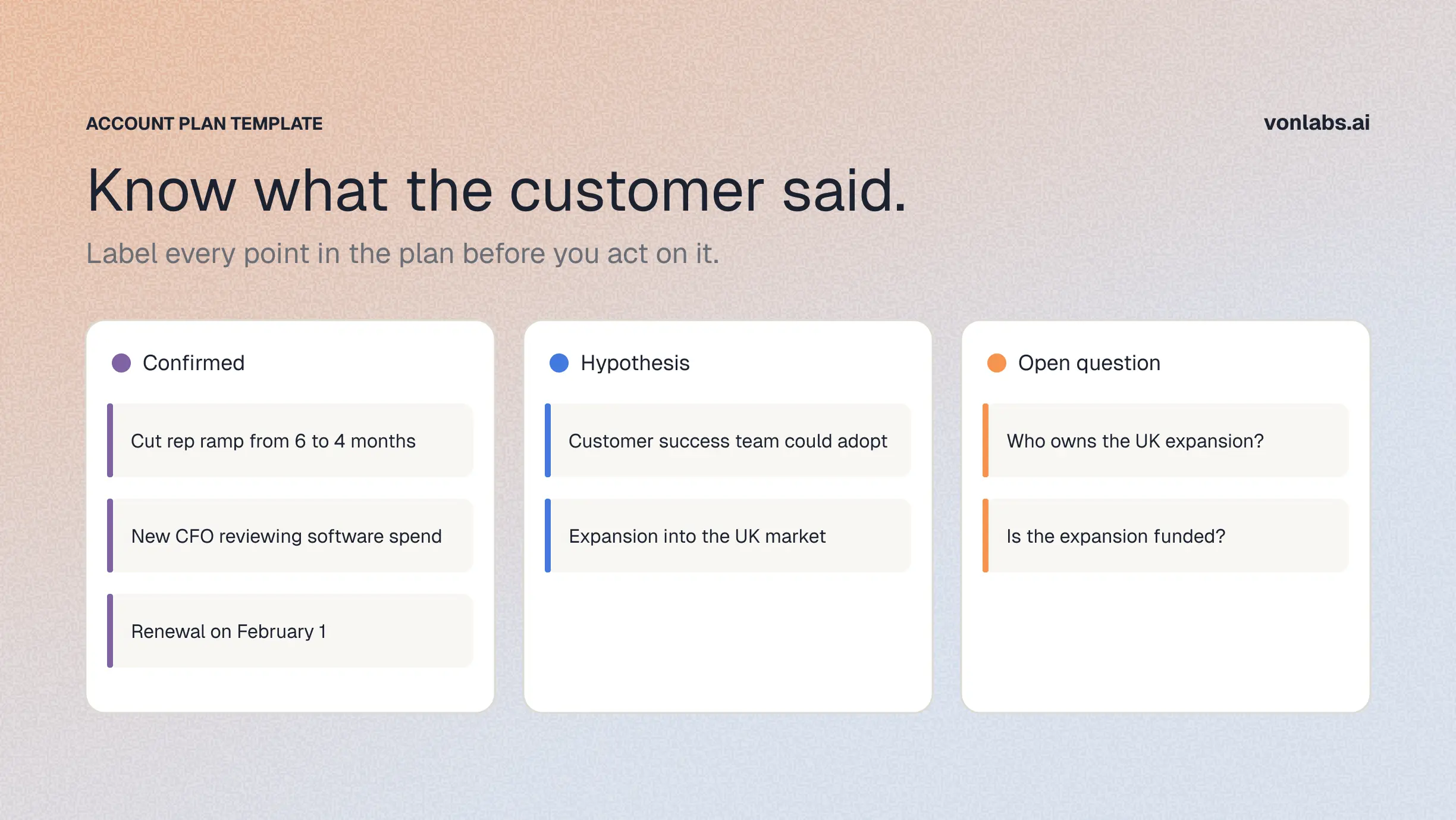
Confirmed, hypothesis, or open question
The single most useful addition to an account plan is a label on every important point:
- Confirmed: the customer said it, or the record shows it, and you can point to where.
- Hypothesis: your team believes it, but the customer has not said it.
- Open question: you do not know yet, and someone needs to ask.
Hypotheses are valuable, because they are where expansion ideas come from. The risk is treating them as facts. A plan that marks the difference tells a manager which opportunities are ready to pursue and which ones need a conversation first.
Account Plan Template
Copy this free template into a shared document or spreadsheet. No email or sign-up is required. Fill in the source and status for each row as you go.
A Worked Example
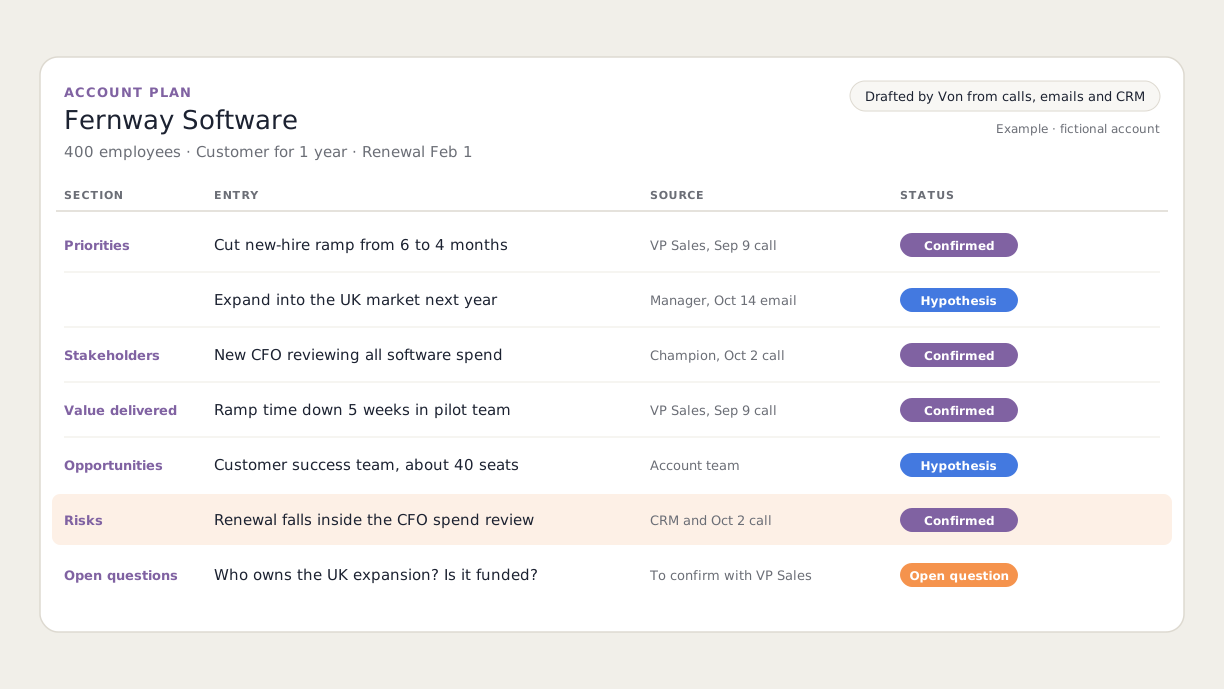
Here is a short example for a fictional customer, Fernway Software, a 400-person company that has used your product in its sales team for a year.
Read this way, the plan points to a clear priority. The confirmed risk, a renewal inside a spend review, comes before either expansion idea. The next steps follow:
- Ask the champion for a meeting with the new CFO before the end of the year, with a short summary of the ramp-time results.
- Confirm the customer success opportunity with the head of that team before adding it to the forecast.
- Ask the VP Sales whether the UK expansion is funded, and who will lead it.
How to Build an Account Plan
- Start from what the customer has said. Read the last few months of calls and emails before you write anything. Use the customer's words for their priorities.
- Add the facts from your CRM. Contract value, renewal date, products, and open opportunities give the plan its baseline.
- Map the stakeholders. Note each person's role, how much influence they have, how they view your team, and when you last spoke.
- Label every important point. Mark each one as confirmed, hypothesis, or open question, and note the source.
- Turn hypotheses and open questions into actions. Each one needs an owner and a date. For a live opportunity, the MEDDPICC scorecard helps decide what to confirm first.
- Review it on a schedule. Monthly for your most important accounts, quarterly for the rest. Bring it to your QBR preparation so the plan and the review tell the same story.
Why Account Plans Go Out of Date
Account plans rarely fail because the template was wrong. They fail because building one takes hours of reading, so it gets done once and then left alone. Sam Sheehy, Manager of Account Management at DemandScience, described how much reading that used to take:
"Getting up-to-speed on an account used to mean combing through dozens of calls, hundreds of emails, and scattered CRM data. Now I'm up to speed in minutes."
When the research takes that long, a plan is only as current as the last time someone had a free afternoon. Stakeholders change, priorities shift, and the plan keeps describing last quarter.
The same problem shows up across a team. If each account owner builds plans from their own notes, two people can describe the same customer differently. That is the same reason AI gives different answers across a team when everyone supplies their own context.
Where Von fits
Von is a GTM AI system of intelligence. Its GTM brain learns how your business works, including your products, your segments, and how your team defines a qualified opportunity. Von reads your CRM records, calls, and emails, so an account owner can ask it to draft an account plan for a customer and get back a document like the example above, with each priority and risk linked to where it came from.
Before a customer meeting, the account owner can ask Von what has changed on the account since the plan was last updated, and which hypotheses the latest conversations support or contradict.
Teams also use Von beyond a single account. Evan Briere, Global Director of New Business, runs a monthly account prioritization model in Von across his team's book of business: "Closed-lost deals get tiered for re-engagement. Dormant accounts get scored and resurfaced."
If you are planning across many accounts rather than one, see how to set up territory planning without a dedicated analyst. For a single meeting, the five-minute call prep routine uses the same sources.
Frequently Asked Questions
What is the difference between an account plan and a mutual action plan? An account plan is your internal strategy for the whole customer relationship across deals and over time. A mutual action plan is shared with the buyer and lists the agreed steps to complete one purchase or project.
What is the difference between a strategic account plan and a key account plan? Most teams use the terms interchangeably for their most important customers. Both follow the same structure as a standard account plan, with more detail on stakeholders, opportunities, and risks, and more frequent review.
Which accounts need an account plan? Start with the accounts that matter most to next year's revenue: your largest customers, accounts with a renewal in the next two quarters, and accounts with a clear expansion opportunity. A short plan for these is more useful than a long plan for every account.
How often should you update an account plan? Review strategic accounts monthly and other planned accounts quarterly. Update the plan sooner when something important changes, such as a new executive, a support escalation, or a renewal coming up.
Can AI write an account plan? AI can draft an account plan from the account's CRM record, calls, and emails, which saves the account owner hours of reading. Check that each priority and risk links to its source, and confirm the hypotheses with the customer before acting on them.
Sources