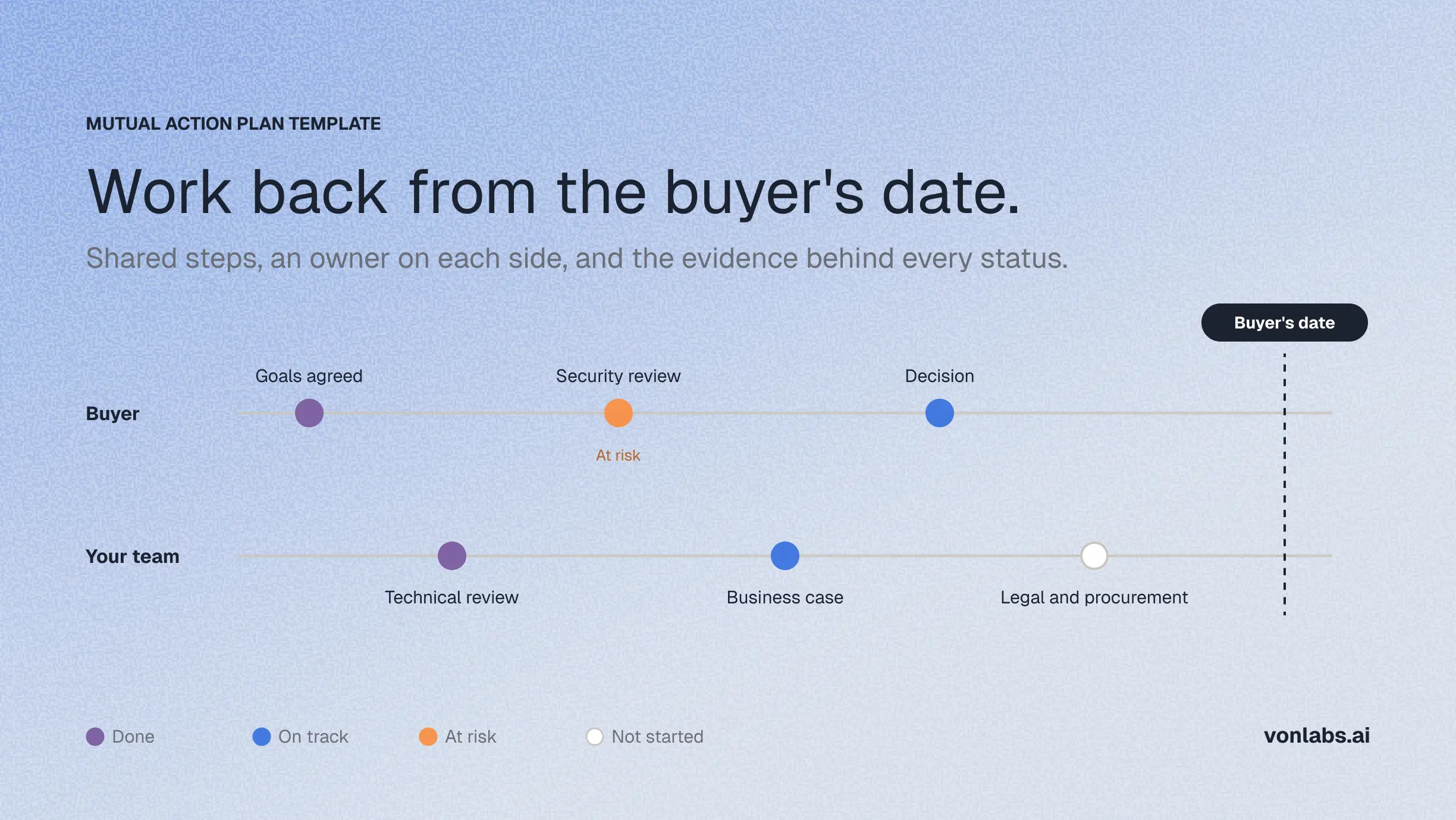
A mutual action plan usually starts strong. The rep and the champion agree on the steps, add dates, and share the document. Three weeks later, the plan says the security review is on track while the buyer's security team has not opened the questionnaire. Nobody updated the plan, so it no longer describes the deal.
This guide gives you a mutual action plan template you can copy, a worked example, and a simple way to keep each step tied to what the buyer has said, so the plan stays useful after the first week.
What Is a Mutual Action Plan?
A mutual action plan (MAP) is a shared document that lists the steps the buyer and seller agree to take, who owns each step, and when it is due, working back from the buyer's goal date. Salesforce notes it is also called a mutual close plan, mutual success plan, or joint execution plan, and that the sales rep typically manages it.
A mutual action plan is different from a close plan. A close plan is the seller's internal view of how the deal will close. A mutual action plan is agreed with the buyer, and the buyer owns some of the steps.
What a Good Mutual Action Plan Includes
- The buyer's goal and date: the outcome they want, in their words, and the date it matters to them.
- Milestones grouped by phase: evaluation, decision, and signature, plus go-live if it is part of the agreement.
- An owner on each side: a named person from the buyer and a named person from your team for every step.
- A due date for every step: worked back from the buyer's date, not your quarter end.
- A status: done, on track, at risk, or not started.
- The evidence behind the status: where the step and its date came from, such as a call, an email, or a meeting.
Most templates stop at status. The evidence column is what keeps a plan honest, because it shows whether a step reflects what the buyer agreed to or what the rep hopes will happen. Salesloft recommends identifying the role responsible for each step first, then the name, which is a useful way to fill the owner columns early.
Mutual Action Plan Template
Copy this free template into a shared document or spreadsheet. No email or sign-up is required. Start with the buyer's goal and date, then add steps working backward.
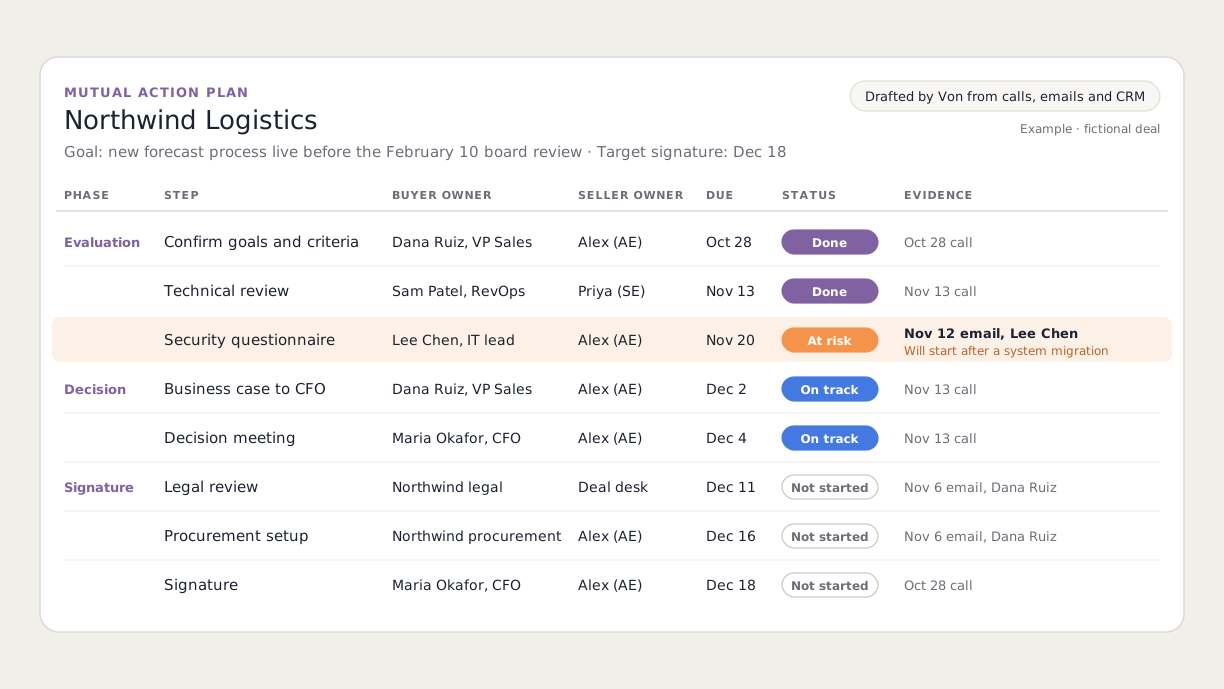
A Worked Example
The example above is for a fictional company, Northwind Logistics, which wants a new forecasting process live before its February board review. The plan works back from that date.
Seven of the eight steps look fine, and the plan shows the deal on track for signature on December 18. One row tells a different story. The security questionnaire was due November 20, and the plan marks it at risk because a November 12 email from the buyer's IT lead says their team will not start it until after a migration. That single row puts every later date in doubt, because legal and procurement are waiting on it.
The right next step is clear from the plan:
- Ask the champion whether the security review can run in parallel with the migration, or whether the decision date should move.
- Offer the buyer's IT lead your existing security documentation so the questionnaire takes less of their time.
How to Build a Mutual Action Plan With a Buyer
- Start from the buyer's date. Ask what has to be true, and by when, for this project to succeed. Use that date as the anchor for every step.
- Draft it before the call, then edit it together. Bring a first version with the steps you already know, and let the buyer correct the steps and dates on their side.
- Name an owner on both sides for every step. A step owned only by your team is a task list. A step the buyer owns is a commitment.
- Turn qualification unknowns into steps. If your MEDDPICC scorecard shows an unknown Economic Buyer or Paper Process, add a dated step to the plan that answers it, such as a meeting with the budget holder or a call with procurement.
- Agree when you will review it. A weekly check during the evaluation is common. Put the review on both calendars.
Signs a Mutual Action Plan Has Stopped Being Accurate
- Dates have passed and the status has not changed. A step due last week that still says on track has not been reviewed.
- The buyer has stopped editing it. If only your team updates the plan, it has become your forecast note.
- A step has no evidence. If nobody can point to the call or email where a step was agreed, it may be an assumption.
- The plan and the conversations disagree. The plan says legal has the contract, but the last call mentions a new approver. This is the most common way a plan goes out of date.
Any of these is worth raising in your pipeline review. They are also early signs of the deal risk covered in Deal Risk Detection, and they often explain why a deal in Commit slips, one of the reasons sales forecasts miss.
How to Keep the Plan Current
The fix is to check the plan against what the buyer said, after every conversation. Before each call, read the plan and the latest messages from the buyer, then confirm any step that has moved. A short call prep routine makes this a five-minute habit. After the call, update the status and add the evidence while the details are fresh.
This works, but it depends on someone reading every call and email for every open deal. For a rep carrying many deals, that review is easy to skip.
Where Von fits
Von is a GTM AI system of intelligence. Its GTM brain learns how your team runs deals, and Von reads your calls, emails, and CRM records. A rep can ask Von to draft a mutual action plan for a deal and get back a document like the example above, with each step's owner, date, and source taken from the conversations.
Before a buyer call, the rep can ask Von to compare the current plan with what the buyer has said since it was last updated. Von points out steps the conversations no longer support, so the rep can confirm them with the buyer instead of finding out at the end of the quarter.
Frequently Asked Questions
What is the difference between a mutual action plan and a close plan? A close plan is the seller's internal plan for winning the deal. A mutual action plan is agreed with the buyer, and both sides own steps in it. Some teams use the term mutual close plan for the shared version.
How many steps should a mutual action plan have? Enough to cover each step from today to signature, without listing every task. Many plans have about seven to ten milestones, with more detail added as the deal gets closer to a decision.
When should you introduce a mutual action plan? Once the buyer has agreed to evaluate and you know their goal and date. Introducing it too early can feel presumptuous, and introducing it after the decision process has started means you have less influence over the steps.
Who should own the mutual action plan? The sales rep usually maintains the document, and the buyer's champion owns the steps on their side. Both should review it together on a regular schedule.
Can AI create a mutual action plan?AI can draft a mutual action plan from the deal's calls, emails, and CRM record, which saves the rep from building one from memory. Treat the draft as a starting point, and confirm the steps and dates with the buyer before sharing it.
Sources