MCP, or the Model Context Protocol, is the new standard for connecting AI applications to the systems where work happens. The official MCP documentation describes it as an open-source standard that lets AI applications connect to external systems, data sources, tools, and workflows. That is a meaningful step forward for revenue teams.
It means a seller can use Claude, ChatGPT, or another compatible AI client to access Salesforce without switching applications. It means developers can build an integration once and use it across multiple AI clients. It means the era of one-off, custom connector work is starting to end.
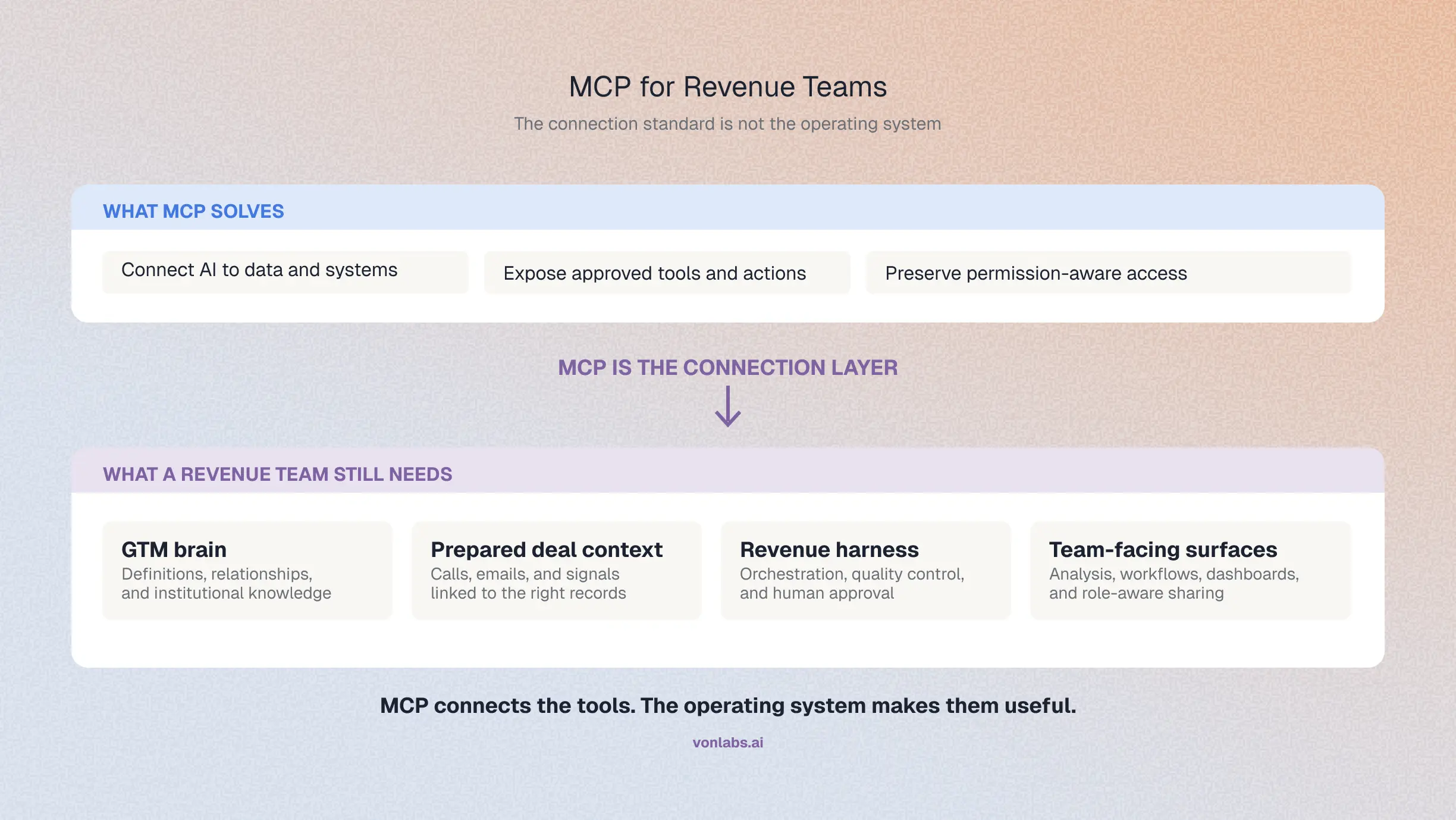
MCP is important. It is also not the complete answer to how a revenue organization uses AI. It connects an AI to data and actions. It does not automatically create the business context, quality controls, data preparation, or team workflows needed to turn those connections into a reliable operating system.
What MCP Gets Right
A common language for AI connections
Before MCP, every AI application and business system needed its own integration pattern. MCP defines a shared model: an AI host uses a client to connect to servers, and servers expose resources, prompts, and tools. The standard gives AI applications a consistent way to discover and use available capabilities.
That interoperability is already becoming concrete for revenue teams. Salesforce announced that its hosted MCP servers became generally available in April 2026 for Enterprise Edition and above. Salesforce says the hosted servers can expose Salesforce data, flows, Apex actions, and queries to compatible AI clients while applying the authenticated user’s existing permissions.
Less integration work
MCP reduces the work required to make an AI application talk to an existing system. That matters for a GTM engineering team that wants to put an AI interface on top of CRM data, account research, or approved workflows. The connection is more reusable, more discoverable, and easier to govern than a collection of bespoke API wrappers.
Better control than unstructured access
The protocol also formalizes how tools are exposed. An MCP server can define the actions an AI is permitted to take instead of granting broad, unstructured API access. The MCP specification makes an important point: tool calls represent arbitrary code execution and require careful access controls and user consent. For revenue teams, that makes human review and permission-aware actions part of the design rather than an afterthought.
Where MCP Stops
MCP connects context. It does not decide what context matters.
A Salesforce MCP server can make pipeline fields available to an AI client. It does not determine whether your organization measures deal value with Amount, ARR, or another custom field. It does not know which opportunity types belong in a forecast, how your fiscal year is named, or whether Stage 1 belongs in qualified pipeline. Those are business definitions, not connector settings.
Without governed definitions, two users can connect to the same system and get different answers because they ask differently or apply different filters. MCP makes data accessible. It does not standardize the meaning of the data.
A server does not create a GTM brain
The MCP specification says servers can expose resources, prompts, and tools. That is useful infrastructure. But a revenue organization still needs a shared model of its semantics, system relationships, and institutional knowledge. It needs to know how a call transcript maps to an opportunity, how an account maps to product usage, and which playbook applies to a renewal risk.
That shared model is the GTM brain. MCP can be one of the ways an AI application reaches it. It is not the brain itself.
It does not prepare unstructured data for analysis at scale
Most revenue evidence is not in neat CRM fields. It is in call transcripts, emails, Slack threads, documents, and customer interactions. Connecting an AI to a call recorder does not automatically make every historical conversation available for a reliable answer. The system still needs ingestion coverage, entity association, signal extraction, semantic retrieval, and a way to review the underlying evidence.
This is the distinction between asking an AI to summarize a call and asking it to identify the objections that appeared across a quarter of calls, then connect those objections to deal outcomes. The second question requires prepared, linked, and reusable deal context.
It does not ship the operating experience
Even with secure MCP connections, a revenue team needs the surfaces where work gets done: analysis, dashboards, recurring workflows, approval flows for CRM updates, role-aware sharing, and a way to investigate an answer. Those are product and operating-design questions, not protocol questions.
MCP gives a foundation model access to capabilities. Someone still has to build the harness that chooses the right capabilities, carries the right context into the task, applies quality controls, and presents the result in a usable workflow.
The Right Way to Think About MCP
MCP is the USB-C port, not the computer. It is a common interface for moving data and actions between AI applications and external systems. For a revenue organization, that is necessary infrastructure. It is not sufficient infrastructure.
The full operating environment has four layers: connectors that reach the systems where GTM work happens; a context graph that contains business and deal context; a revenue harness that orchestrates multi-step work; and team-facing surfaces for chat, analytics, workflows, and applications. MCP sits primarily in the connector layer. Its value grows when the other layers are in place.
What This Means for Revenue Teams
Adopt MCP. It makes your AI stack more flexible, reduces custom integration work, and lets you preserve user permissions when connecting AI clients to systems such as Salesforce. It is a strong technical decision.
Do not mistake that decision for an AI strategy. If the goal is a production-grade system that your RevOps leader, managers, AEs, and CSMs can all use, plan for the business context and operating layer as deliberately as the connector layer. Ask who owns definitions, how signals are associated to deals, how data is prepared, how access is scoped, and how answers are checked.
Von is designed around the complete operating environment. It connects structured and unstructured GTM systems, builds a GTM brain that combines semantics, ontology, and memory, and uses a revenue harness to turn that context into analysis and action. MCP can make connections easier. Von’s job is to make the connected intelligence useful to the entire revenue organization.
Frequently Asked Questions
What is MCP? MCP, or Model Context Protocol, is an open-source standard that lets AI applications connect to external systems, data sources, tools, and workflows. It defines a common way for AI hosts, clients, and servers to share capabilities.
What can MCP do for a revenue team? MCP can connect an AI client to systems such as Salesforce, databases, internal tools, and approved workflows. It can help sellers and operators retrieve data and take permission-aware actions without changing applications.
Is MCP a replacement for a revenue intelligence platform? No. MCP is a connection standard. A revenue intelligence platform adds the business definitions, deal context, data preparation, governance, and team-facing workflows required to turn connected systems into a reliable operating capability.
Does MCP provide business context? MCP can expose resources that contain context, but it does not determine which business definitions are authoritative, connect evidence to the right entity, or keep organizational knowledge current. Those are context and governance responsibilities built above the protocol.
Is MCP secure for Salesforce? Salesforce’s hosted MCP servers apply the authenticated user’s existing Salesforce permissions, including CRUD, field-level security, and sharing rules. MCP implementations still require careful configuration, access control, and user consent for tool actions.
AI for Revenue Teams: Build vs. Buy
- Why Building a SalesGPT Is Harder Than You Think
- Claude for Revenue Teams: What Works and What Breaks
- ChatGPT Work for Sales: What It Does and What It Does Not
- The Hidden Cost of DIY Revenue Intelligence
- What Is a GTM Brain? (And Why Skill Files Are Not One)
- MCP for Revenue Teams: Promise vs. Reality