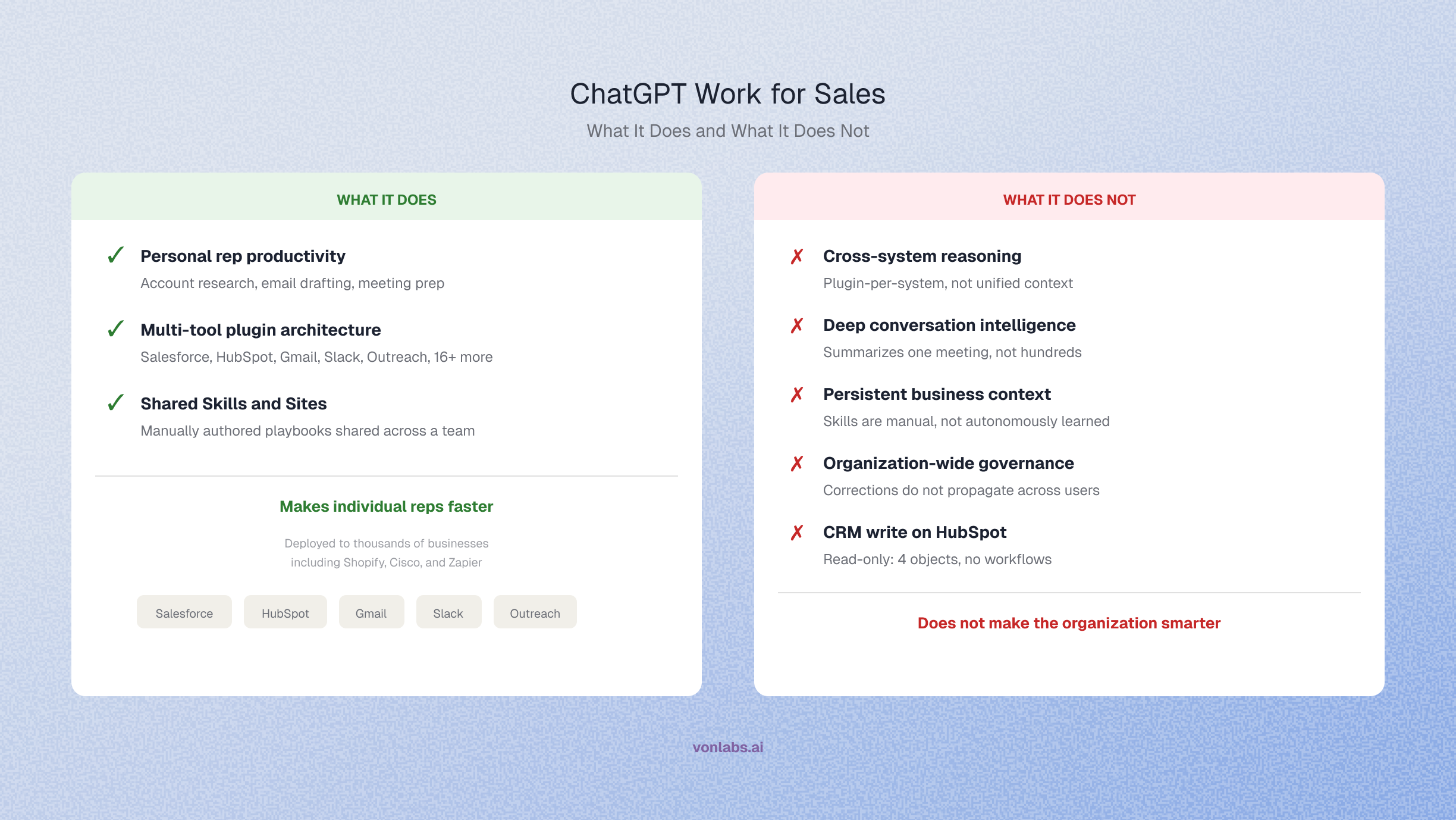
OpenAI launched ChatGPT Work for sales teams with plugins for Salesforce, HubSpot, Gmail, Slack, Outreach, and over a dozen other tools. The pitch is straightforward: connect your sales stack, ask questions in natural language, and delegate research and follow-ups to AI agents.
The product is real and the integrations work. Thousands of businesses are using it. The question for revenue teams is whether ChatGPT Work replaces the need for a purpose-built GTM intelligence system, or whether it fills a different role.
The answer depends on what you need it to do.
What ChatGPT Work Does Well
ChatGPT Work is strongest as a personal productivity tool for individual sellers. It connects to your CRM and email, and it handles the tasks that eat up a rep’s morning: researching an account before a call, drafting a follow-up email, summarizing a meeting, or pulling a quick pipeline number.
The plugin architecture is genuinely useful. A rep can connect Salesforce, Gmail, and Google Calendar in one workspace and ask ChatGPT to prepare for tomorrow’s meetings using data from all three. For a single user doing single-session work, this is a meaningful productivity gain.
OpenAI also introduced "Skills" and "Sites" to capture and share playbooks across a team. This is their answer to the governance problem: instead of every rep prompting differently, a manager can create a shared skill that standardizes how the team runs account research or deal reviews.
Where It Stops
Plugin-per-system, not cross-system reasoning
Each plugin connects to one tool. The Salesforce plugin reads Salesforce. The HubSpot plugin reads HubSpot. The Gmail plugin reads email. But the hardest revenue questions require combining data across systems: "Which deals have gone dark based on CRM activity, email engagement, and call recordings?" ChatGPT Work can pull from each plugin sequentially, but it cannot hold the combined context of a deal’s CRM record, its last five call transcripts, and its email thread history in a single reasoning pass.
Read-only on key systems
The HubSpot connector is read-only, limited to four objects (Contacts, Companies, Deals, Tickets), and excludes custom sensitive data. It cannot create, edit, or delete records. It cannot trigger workflows or sequences. The Salesforce plugin has write access through Agentforce, but the depth of what you can automate depends on your Salesforce edition and Agentforce configuration.
No deep conversation intelligence
ChatGPT Work connects to Otter.ai and Granola for meeting notes, but it does not have a native call recording integration that preprocesses and indexes thousands of calls. A manager asking "what objections are coming up most across my team this quarter" needs analysis across hundreds of transcripts. ChatGPT Work cannot do this because it does not store, vectorize, or preprocess call data. It can summarize one meeting at a time.
No persistent business context
Skills and Sites are a step toward organizational memory, but they are manually authored and maintained. They do not learn from your CRM metadata, your call recordings, or your historical win/loss patterns. If your fiscal year starts in February, someone has to write that into a skill. If your team uses a custom ARR field instead of the standard Amount field, someone has to document that. Every org-specific definition requires manual upkeep.
Session-scoped, not organization-scoped
When one rep discovers that a particular prompt works well, that knowledge stays with them unless a manager manually captures it in a shared skill. When a RevOps leader corrects a definition, the correction does not propagate to every user’s context. The system does not compound from usage. Each session is independent. That is one of the main reasons AI gives different answers across a team.
What This Means for Revenue Teams
ChatGPT Work is a strong personal productivity layer. It makes individual reps faster at the tasks they already do: research, drafting, and CRM lookups. For teams that need a quick AI layer on top of their existing stack without deep customization, it delivers real value.
It is not a GTM system of intelligence. It does not build a go-to-market brain that understands your pipeline stages, revenue definitions, sales methodology, and institutional knowledge. It does not preprocess and analyze thousands of calls to surface deal risk or competitive patterns. It does not enforce standardization across an organization so that every user gets the same quality answer to the same question.
That is the layer Von builds. Von connects to the same systems ChatGPT Work connects to, but it spends 3 to 7 days autonomously learning your business before anyone asks a question. It preprocesses all unstructured data so it can reason across thousands of calls in a single query. And it maintains a shared organizational memory that compounds from every interaction.
ChatGPT Work and Von solve different problems. ChatGPT Work makes individual reps faster. Von makes the entire revenue organization smarter.
Frequently Asked Questions
What is ChatGPT Work for sales? ChatGPT Work is OpenAI’s enterprise product that connects to sales tools like Salesforce, HubSpot, Gmail, Slack, and Outreach via plugins. It allows sales reps to research accounts, draft emails, summarize meetings, and pull CRM data using natural language.
Can ChatGPT Work write to Salesforce and HubSpot? It depends on the system. The Salesforce plugin supports read and write through Agentforce. The HubSpot connector is read-only, limited to Contacts, Companies, Deals, and Tickets. It cannot create, edit, or delete records in HubSpot.
Does ChatGPT Work analyze call recordings? Not natively. It connects to Otter.ai and Granola for meeting notes, but it does not preprocess or index call recordings at scale. It can summarize a single meeting transcript but cannot analyze patterns across hundreds of calls.
How is ChatGPT Work different from a revenue intelligence platform? ChatGPT Work is a personal productivity tool that connects to your sales stack via plugins. A revenue intelligence platform adds persistent business context, preprocessed unstructured data, cross-system reasoning, organizational memory, and team-wide governance. ChatGPT Work makes individual reps faster. A revenue intelligence platform makes the organization smarter.
AI for Revenue Teams: Build vs. Buy