Connecting Claude to Salesforce takes about 30 minutes. Salesforce published the guide in May 2026. OpenAI launched ChatGPT Work with a sales plugin that connects to Salesforce, HubSpot, Slack, and Outreach. The infrastructure to build your own AI sales tool has never been more accessible.
And that is exactly why so many teams are trying. A RevOps leader connects Claude to Salesforce, asks it a pipeline question, gets a reasonable answer, and thinks: we can build this ourselves.
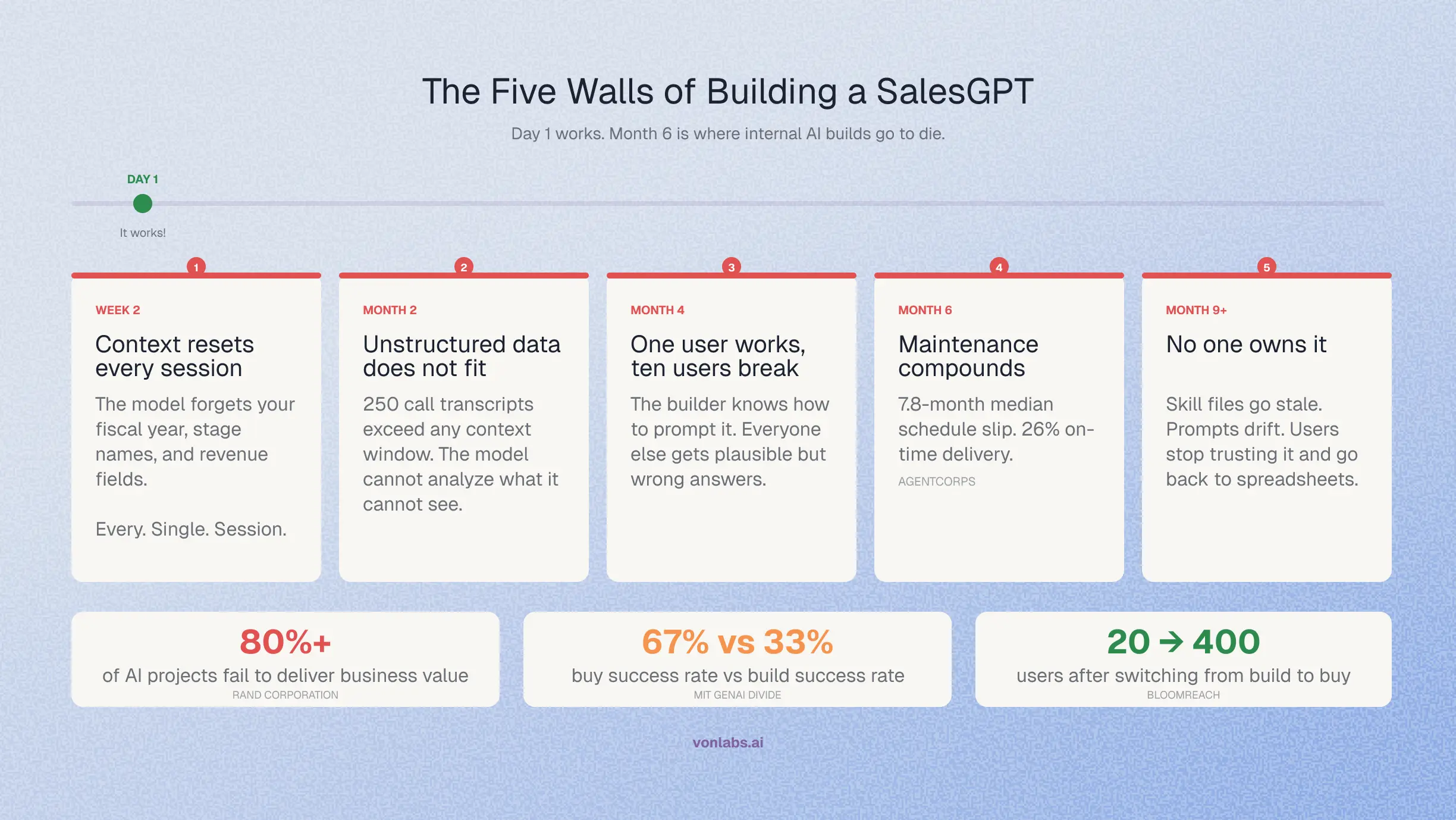
They are right about the first 10%. The last 90% is where it breaks. According to RAND Corporation research, more than 80% of AI projects fail to deliver business value. MIT’s GenAI Divide study found that companies purchasing AI from specialist vendors succeed about 67% of the time, while internal builds succeed only one-third as often.
What Works on Day One
The initial setup is real. Within an hour, a team can connect Claude or ChatGPT to their CRM and get answers to basic questions: What deals are closing this quarter? Who owns the Acme account? What is our pipeline by stage?
This is not a trick. The model is reading structured CRM data and returning it in natural language. For simple lookups, it works. The problem is that simple lookups are not what revenue teams need.
The Five Walls You Hit After Day One
Wall 1: Context resets every session
Claude and ChatGPT start from zero every conversation. They do not know your fiscal year starts in February, that "Stage 2" means Solution Demonstration, that "New_ARR__c" is the correct revenue field instead of Amount, or that your team excludes CS reps from pipeline reports. Every user has to re-teach these facts every session, or someone has to maintain a growing library of skill files and system prompts.
Wall 2: Unstructured data does not fit
CRM data is the easy part. The hard part is call recordings, email threads, Slack messages, and support tickets. A single call transcript is 10,000-20,000 tokens. A manager with 5 reps, 10 deals each, and 5 calls per deal has 250 transcripts. That exceeds any context window. The model cannot analyze what it cannot see.
Wall 3: One user works, ten users break
The RevOps leader who built the prototype knows how to prompt it. They know which fields to reference, which caveats to add, and how to interpret ambiguous answers. When they hand it to an AE who asks "how is my pipeline looking?" the model returns something plausible but wrong, because it does not know what "my" means, which pipeline fields to use, or which stages to exclude.
Wall 4: Maintenance compounds
Every CRM field change, every new picklist value, every org restructure requires updating the skill files, system prompts, and custom logic. AgentCorps research found that internal first-time AI builds have a median schedule slip of 7.8 months with an on-time delivery rate of 26%. The prototype took a week. The production system takes a year.
Wall 5: No one owns it
The RevOps leader who built the prototype has a day job. The engineering team that was supposed to productionize it has other priorities. The skill files go stale. The prompts drift. Users stop trusting the answers and go back to spreadsheets. This is not a technology failure. It is an ownership failure, and it is the most common reason internal AI projects die.
The Build Timeline vs. the Buy Timeline
What This Means for Your Team
If you are evaluating whether to build or buy an AI layer for your revenue team, the question is not whether Claude or ChatGPT can connect to your CRM. They can. The question is whether your team has the engineering capacity to build and maintain the context layer, the data preprocessing, the multi-user permissions, and the ongoing prompt management that turns a prototype into a production system.
Von is a GTM system of intelligence that spends 3-7 days autonomously building a GTM brain for your business: your pipeline stages, revenue definitions, sales methodology, team structure, and institutional knowledge. It preprocesses and vectorizes all unstructured data so it can analyze thousands of calls in a single query. And it maintains a shared organizational memory so that when one user corrects a definition, the correction applies to everyone.
Bloomreach spent 6 months with 5 engineers building this harness themselves. Then they tried Von and went from 20 users to 400 in a few weeks. Their VP of GTM Strategy called it “the diamond in the pile.”
Frequently Asked Questions
Can I build my own AI sales tool with Claude or ChatGPT? Yes, for basic CRM queries. Connecting Claude to Salesforce via MCP takes about 30 minutes and works for simple lookups. The challenge begins when you need org-specific context, unstructured data analysis, multi-user rollout, and ongoing maintenance. Internal builds succeed about one-third as often as purchasing from specialist vendors, according to MIT research.
How much does it cost to build an internal AI sales tool? A mid-complexity custom AI build costs $40,000-$250,000 and takes 3-9 months, with a success rate of approximately 33%. Enterprise-grade systems cost $250,000 to over $1 million and take 6-18 months. These estimates do not include ongoing maintenance, which typically requires dedicated engineering resources.
What is the failure rate for internal AI projects? More than 80% of AI projects fail to deliver business value, according to RAND Corporation. For generative AI specifically, MIT found that 95% of enterprise GenAI pilots show no measurable financial return. Gartner predicts over 40% of agentic AI projects will be canceled by the end of 2027.
What is the difference between connecting Claude to Salesforce and building a revenue intelligence platform? Connecting Claude to Salesforce gives you a natural language interface to structured CRM data. A revenue intelligence platform adds a context graph (org-specific definitions), data preprocessing (call and email analysis at scale), shared organizational memory, multi-user permissions, and managed infrastructure. The connection is the first 10%. The platform is the other 90%.
Should I build or buy AI for my sales team? If your team has 3-5 dedicated AI engineers, 6-12 months of runway, and a clear owner for ongoing maintenance, building can work for narrow, well-defined use cases. For a production-grade intelligence layer that serves the entire GTM team, buying from a specialist vendor succeeds twice as often and deploys in days instead of months.
AI for Revenue Teams: Build vs. Buy