The build-versus-buy conversation usually starts with a number. An engineering lead estimates two engineers for four months, prices it at roughly $150,000 in salary, and compares that to a vendor quote.
That comparison is wrong before it begins, because the two numbers measure different things. The vendor quote is an ownership cost. The internal estimate is a development cost. One of them includes the next five years. The other stops at launch.
Gartner’s research on agentic AI total cost of ownership puts ongoing maintenance for internally built systems at 30 to 60 percent of initial development cost annually. Not to improve the system. To keep it working.
What Gets Budgeted
Most internal estimates include four things: engineering salary for the build window, cloud and compute costs, LLM API fees, and some allowance for tooling. These are the costs that are easy to see, easy to quantify, and easy to defend in a budget meeting.
The salary line alone is larger than most teams assume. Built In puts the average US AI engineer base salary at $184,757, with total compensation at $211,243. In San Francisco, the average base is $246,250. Two engineers for four months is not $150,000. Fully loaded with benefits and payroll taxes, it is closer to $180,000 before anyone writes a line of code that ships.
In practice, the maintenance burden shows up around month six. The first version works, and then every change becomes an engineering ticket: a new stage, a renamed field, a revised definition of qualified pipeline. RevOps knows what needs to change but cannot make the change, so updates queue behind product work. Teams we speak with describe maintenance, not the original build, as the bottleneck that stalls an internal tool.
What Does Not
The maintenance line
This is the big one. Every CRM field change, picklist addition, org restructure, and API version bump requires updating the system. Skill files go stale. Prompts drift. Integrations break when a vendor changes an endpoint. At 30 to 60 percent of the build cost annually, a $400,000 build carries $120,000 to $240,000 in maintenance every year after launch.
The opportunity cost of the engineers
Revenue intelligence infrastructure is enabling infrastructure. It does not differentiate the company in its market. The engineers building it are not building the product customers pay for. For most companies this is the largest hidden cost on the list, and it never appears in the budget because it is not a cash expense.
The RevOps time before and after launch
Someone has to define what "pipeline" means, which fields are authoritative, how stages map to the sales process, and which users see which data. That someone is a RevOps leader, and the work does not stop at launch. Every definition change requires another round of documentation, another skill file update, and another validation pass.
The adoption cost
A tool that one power user can operate is not a deployed system. Getting a GTM team to trust and use an internal AI tool requires training, documentation, support, and a feedback loop for when answers come back wrong. Teams that skip this step build something technically functional that nobody uses.
The rebuild clock
Gartner’s strategic planning guidance assumes most agentic AI systems built before 2028 will require replatforming or rebuilding by 2030. The foundation model layer is moving faster than any internal roadmap. A system architected around today’s context limits and today’s tool-calling patterns is a system with a shelf life.
The Full Picture
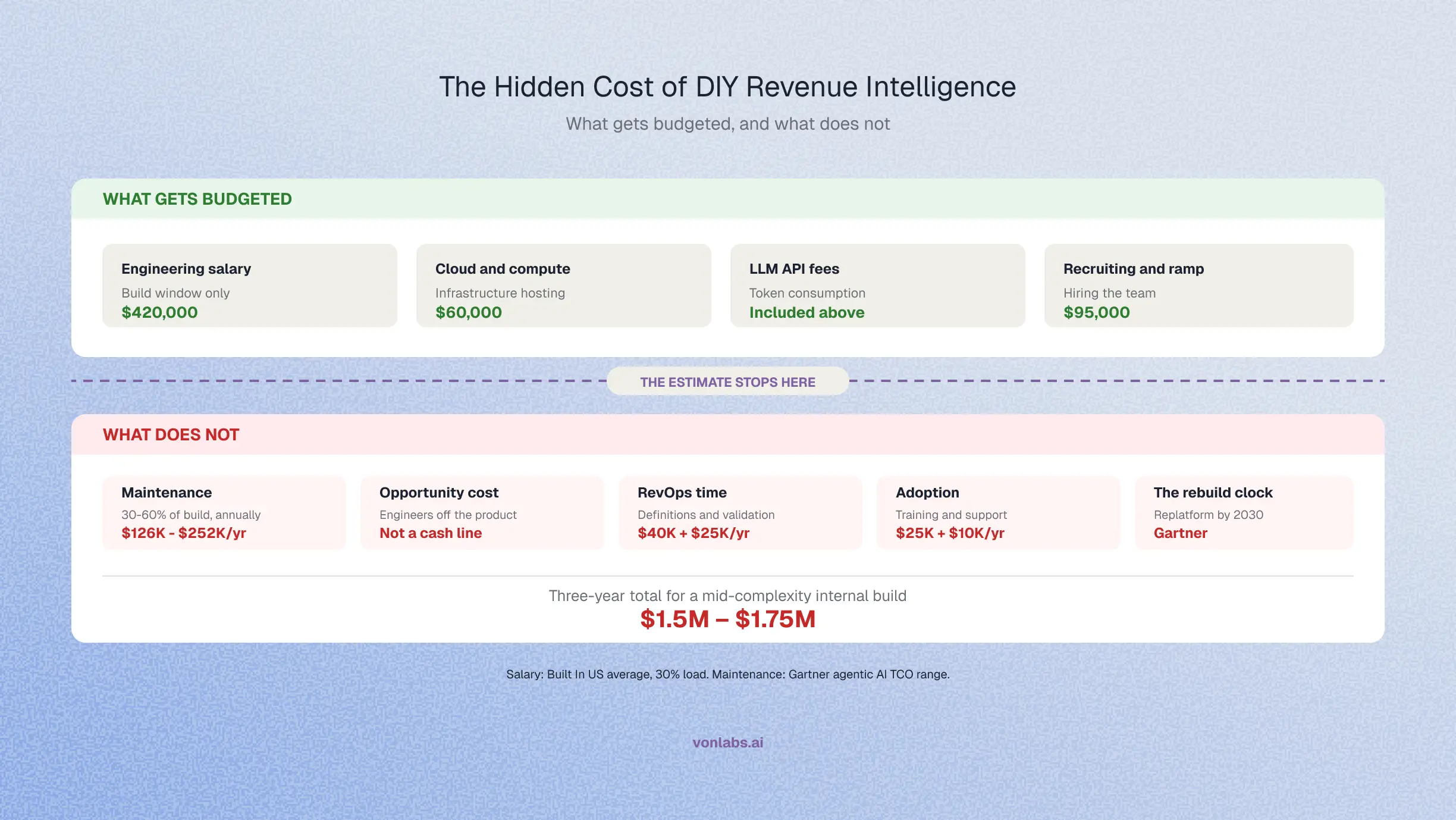
Put the visible and invisible costs in the same table and the comparison changes shape. Below is a three-year view of a mid-complexity internal build: two AI engineers, a six-month build window, and a GTM team of 50.
Three-year total: roughly $1.5 million to $1.75 million. Salary figures use Built In’s US average with a standard 30 percent load for benefits and payroll taxes. Maintenance uses the Gartner range applied to the year-one build. Adjust the inputs for your market and team size, but keep every line: the ones that get dropped are the ones that break the budget.
When Building Still Makes Sense
There are real cases for building. If the intelligence layer is your product rather than infrastructure for your product, build it. If you have a genuinely unusual data model that no vendor can accommodate, build it. If you have dedicated AI engineers with no higher-value roadmap and a named owner accountable for the system in year three, build it.
What does not work is building because the first prototype was easy. The prototype is the cheapest part of the project and the least predictive of what follows.
What This Means
The alternative is buying the layer instead of building it. Von is a GTM system of intelligence that connects to your CRM, call recorder, email, Slack, and data warehouse, then spends 3 to 7 days autonomously building a GTM brain: your pipeline stages, revenue definitions, sales methodology, team structure, and institutional knowledge. The maintenance, the model upgrades, and the infrastructure are the vendor’s problem, not a line item on your engineering roadmap.
Bloomreach spent six months with five engineers building this themselves before switching. They went from 20 users to 400 in a few weeks. The six months of engineering time was the cost they had already paid before the comparison started.
Frequently Asked Questions
How much does it cost to build an internal AI tool for a revenue team? A mid-complexity internal build runs roughly $640,000 in year one and $431,000 to $557,000 annually thereafter, once salary, recruiting, infrastructure, maintenance, RevOps time, and adoption are included. The three-year total lands between $1.5 million and $1.75 million. Development-only estimates typically capture less than half of this.
What is the annual maintenance cost of an internally built AI system? Gartner puts ongoing maintenance for internally built agentic AI systems at 30 to 60 percent of initial development cost per year. On a $400,000 build, that is $120,000 to $240,000 annually, and it covers keeping the system current rather than improving it.
What is the average salary for an AI engineer in 2026? Built In puts the average US AI engineer base salary at $184,757 with total compensation at $211,243. San Francisco averages $246,250 base. Fully loaded with benefits and payroll taxes, budget roughly 30 percent above base.
Should we build or buy revenue intelligence? Build when the intelligence layer is your product, when your data model is genuinely unusual, or when you have dedicated AI engineers and a named owner accountable for the system three years out. Buy when it is enabling infrastructure rather than a differentiator, which is the case for most revenue organizations.
Why do internal AI cost estimates come in low? Because they estimate development cost rather than ownership cost. The estimate typically covers engineering salary for the build window, compute, and API fees, and omits maintenance, opportunity cost, RevOps time, adoption, and the eventual rebuild.
AI for Revenue Teams: Build vs. Buy
- Why Building a SalesGPT Is Harder Than You Think
- Claude for Revenue Teams: What Works and What Breaks
- ChatGPT Work for Sales: What It Does and What It Does Not
- The Hidden Cost of DIY Revenue Intelligence
- What Is a GTM Brain? (And Why Skill Files Are Not One)
- MCP for Revenue Teams: Promise vs. Reality